The Endurance of Hardware Iteration
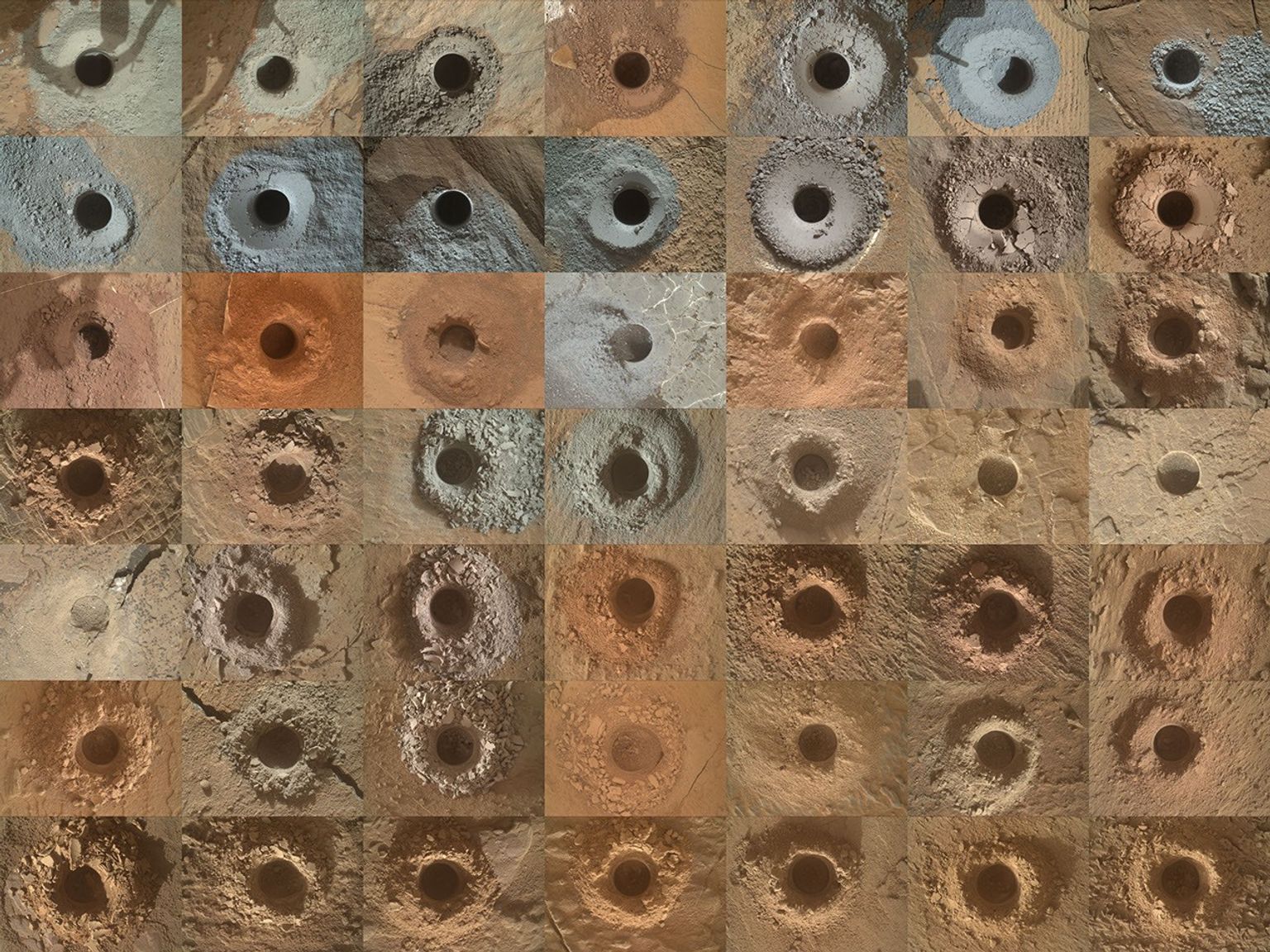
NASA just released a collage of 49 drill holes on Mars. To the average observer, it looks like a collection of dusty circles. To a founder, it looks like a masterclass in long-tail technical debt management and hardware endurance. These holes represent over a decade of grinding—literally and figuratively—on a planet that wants to kill every circuit board and motor we send there.
Curiosity has been operating far beyond its original warranty. The rover is currently sitting in the foothills of Mount Sharp, and every one of these 49 samples represents a moment where the engineering team had to bet their life's work on a single robotic arm. When you are building in Web3 or AI, you talk about 'uptime.' When you are building for Mars, uptime is a matter of physical survival against the elements.
The Logistics of Remote Sampling
Each of these 49 holes is a data point. The process is deceptively simple: the rover uses a percussion drill to turn Martian rock into powder, then feeds that powder into its internal chemistry labs, SAM and CheMin. But think about the latency. You aren't just pushing code to a cloud server. You are sending commands across millions of miles of void, waiting for a response, and praying the drill bit doesn't jam in a rock that hasn't been touched in three billion years.
For builders, there is a lesson here about localized processing. Curiosity doesn't send the rocks back to Earth; it processes them in its 'belly.' It’s the ultimate edge computing use case. In our world, we argue about decentralized storage and latency. On Mars, if you can't process the data locally, the mission is effectively dead. The rover has to be smart enough to handle the telemetry and the physical mechanics of the drill without constant hand-holding from mission control.
Infrastructure Over Hype
I look at this collage and I don't see a scientific breakthrough; I see infrastructure that worked. In the crypto space, we see a lot of 'vanguard' projects that launch with massive hype and then crumble when the first 'drill bit' hits a hard patch of reality. Curiosity didn't start with 49 holes. It started with one. Then it survived the Martian winter. Then it survived the dust storms. Then it did it again.
The cumulative value of these 49 samples is higher than the sum of their parts. By sampling across different elevations and geological layers, NASA is building a historical ledger of the planet. It’s a blockchain of dirt. Each sample is a block, time-stamped by its location in the sedimentary record. You can't understand the history of Martian water by looking at one hole. You need the full sequence.
The Founder’s Takeaway on Resilience
What can a software founder learn from a piece of machinery that spends its days poking holes in a red desert? It’s the discipline of the repetitive task. We often get bored with the 'maintenance' phase of a startup. We want to pivot to the next shiny thing. But NASA has spent years doing the exact same mechanical motion because that is where the truth is hidden.
There is no 'growth hacking' on Mars. There is only the mechanical integrity of your tools and the patience of your team. The rover’s wheels are falling apart, its power source is slowly decaying, and yet it just finished its 49th sample. That is the kind of grit I want to see in the projects I cover. If your protocol can't survive a bear market, it certainly wouldn't survive the Gale Crater.
Technical Debt and the Robotic Arm
Every time Curiosity drills, it risks a catastrophic failure. A stuck drill could end the primary mission. This is the equivalent of a major smart contract upgrade. You prepare, you simulate, you cross your fingers, and you execute. The fact that they have reached 49 without a mission-ending mechanical failure is a testament to the quality of the initial build.
In the AI space, we see a lot of 'black box' solutions where nobody knows why the model is outputting a specific result. NASA can't afford that. Every movement of that arm is calculated. Every grain of powder is accounted for. There is a transparency in this mechanical process that we should strive for in our digital systems.
What Happens at Hole 50?
As we approach the 50th sample, the narrative isn't just about finding life or water. It's about the proof of work. This collage is a visual representation of a decade of successful execution. It’s a reminder that real progress is slow, dusty, and often repetitive.
- Build for the long haul: If your project can't last ten years, don't bother starting.
- Localize your power: Edge processing and autonomous decision-making are the future of all complex systems.
- Iterate on the boring stuff: The 49th hole is just as important as the first one.
Stop looking for the 'moonshot' and start looking for the 'drill site.' The builders who win are the ones who keep turning the bit, even when the rest of the world has stopped watching the livestream. 49 holes might not sound like a lot over 12 years, but when those holes are on another planet, they are the only metrics that matter.
Read the original at NASA Breaking News →