CoinDesk 20 performance update: AAVE jumps 8.9%, leading index higher
Solana (SOL) gained 4.5%, joining Aave (AAVE) as a top performer.
Originally on CoinDesk →C
CoinDesk
Contributor
Jun 26, 2026
4 min read
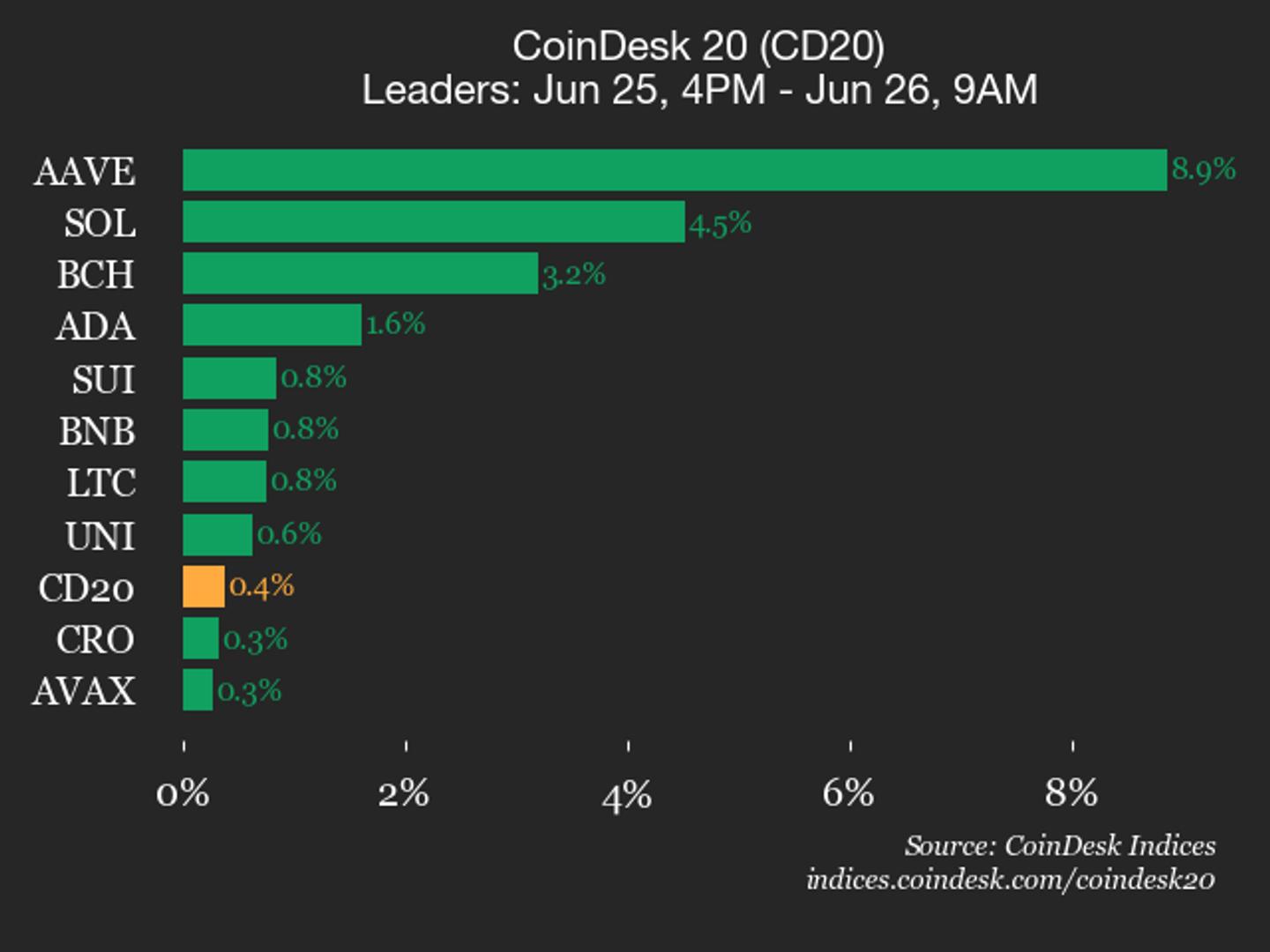
Photo illustration / STKR News
 STKR News0 of 3 free this month
Solana (SOL) gained 4.5%, joining Aave (AAVE) as a top performer.
Originally on CoinDesk →CoinDesk
Contributor
Jun 26, 2026
4 min read
Photo illustration / STKR News
The market is sending a message that most speculators are too distracted to hear. While the crowd waits for a retail mania that may never come back in the same way, the blue chips of the decentralized finance world are quietly decoupling from the noise. CoinDesk reports that Aave surged 8.9 percent, leading the index higher, while Solana posted a solid 4.5 percent gain to join it at the top of the board.
Most operators treat price action like a dopamine hit rather than a signal. You see a 4 percent move in Solana or nearly 9 percent in Aave and you look for a reason to trade the news. This is a mistake. The hard truth is that short term price fluctuations in a twenty asset index mean nothing if you do not understand why these specific assets are leading the pack. We are seeing a flight to quality that happens every time the market gets exhausted by vaporware. Aave represents the foundation of lending, and Solana represents the foundation of execution speed. If you are building on anything else right now, you are fighting an uphill battle against established network effects.
The deeper problem is the distraction of choice. Founders think they need to be on every chain or support every protocol to survive. They chase the newest incentive program or the latest experimental layer. This dilutes your focus and your brand. When Aave and Solana lead the index, it tracks a return to infrastructure that actually works. Most of the industry is still trying to solve problems that Aave solved three years ago. If your project relies on a complex chain of bridges and experimental security models, you are adding risk that the market is currently pricing out. High performance assets are not just lucky; they are resilient because they have moved past the trial phase and into the utility phase.
Brand is not just a logo, it is the market's trust in your ability to settle a transaction without it disappearing into a black hole.
You need to reframe how you look at these performance updates. A 4.5 percent gain for Solana is not just a number on a chart. It is a sign of institutional and developer consolidation. The index is filtering out the garbage, and the assets left standing are the ones providing real throughput. For a founder, this means your tech stack is your most important strategic decision. If you build on a lagging ecosystem, you are inheriting its lack of liquidity and its reputational baggage. You cannot market your way out of a slow, expensive, or ghost town network.
I have watched these cycles play out since 2007 in traditional tech and since the early days of crypto. The pattern is always the same. First, everyone explores. Then, everyone gets burned. Finally, everyone settles on the two or three systems that actually work. We are in the settling phase. Aave has stayed relevant because it does one thing extremely well: it manages risk. Solana has stayed relevant because it does one thing extremely well: it moves fast. If your business model is more complicated than the value proposition of the layer you are building on, you will lose. Simplicity is the only way to scale when the market is looking for safety.
To survive as an operator, you need a system for evaluating where to place your bets. I call this the Foundation First framework. You analyze an asset’s performance not based on the percentage gain, but on its relationship to the broader market index. If the index is up, you look for what is dragging it higher. Those are your partners. Those are your rails. CoinDesk numbers show that Aave and Solana are currently the engines of the index. This tells you that the market trusts the execution layer and the lending layer more than the fringe assets.
Proof of this pattern exists in every major technological shift. In the early web, people built portals that tried to do everything. They failed. The companies that built the specific infrastructure for search, for social, and for commerce won because they became the rails for everyone else. Aave is becoming a rail. Solana is becoming a rail. When you see these assets leading an index, it is a lagging indicator of developer activity that happened six months ago. The smart money and the smart builders have already migrated. If you are just now noticing that these assets are outperforming, you are already behind the curve.
Do not get caught up in the hype of an 8.9 percent jump. That is a distraction for people who trade on their phones in between meetings. Look at the sustained dominance of the top of the list. If you are an investor, you should be asking why the other 18 assets in that index are trailing. If you are a founder, you should be asking if your project could survive if the bottom 18 assets disappeared tomorrow. The answer for most is no, which means you have a brand problem disguised as a market problem.
Performance leads in Aave and Solana prove that the market is gravitating toward functional utility and away from speculative noise. You cannot build a lasting business on unstable ground, and the current index data tells you exactly where the ground is firm. Audit your current roadmap and strip away any dependencies on low performance or low liquidity networks by the end of this week.
A six-minute morning dispatch on the markets and the technology shaping them.
Free. No spam. Unsubscribe anytime.
Earn $STKR for published stories on markets, protocols, and culture.
Comments
24 reader responses