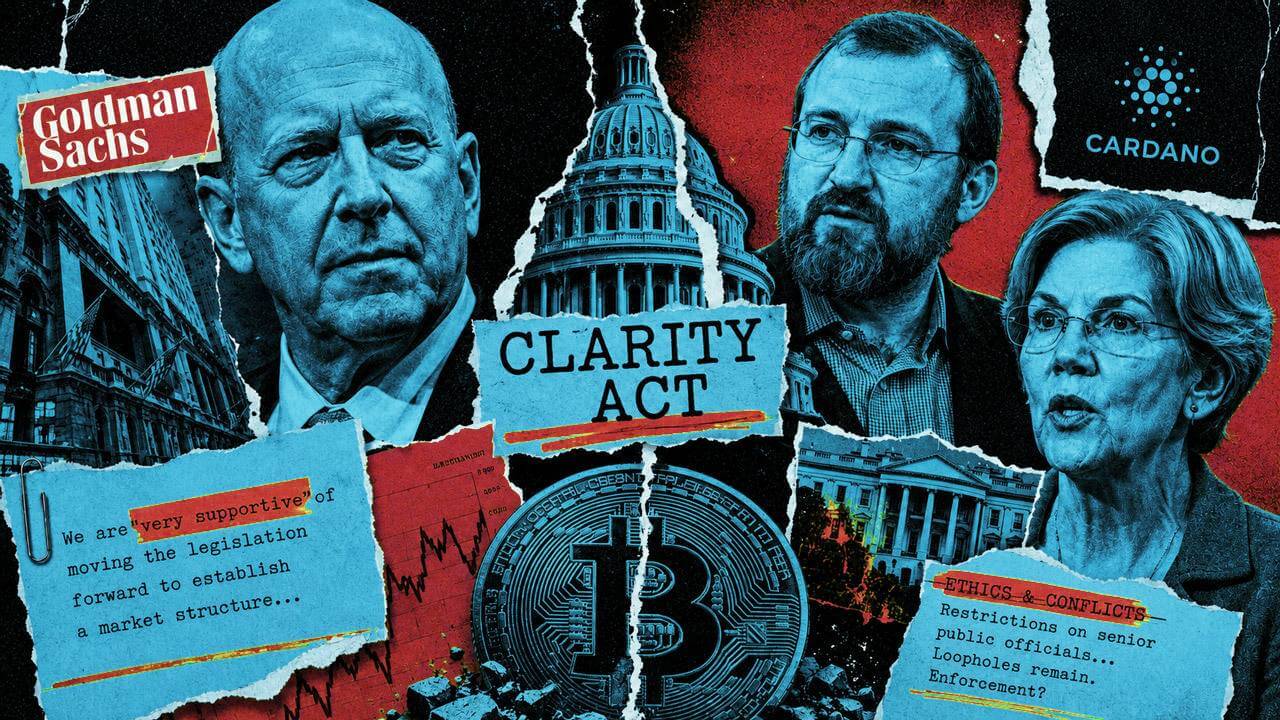
The CLARITY Act was supposed to be a straightforward piece of legislation to define how the United States handles digital assets, specifically stablecoins and the potential for a central bank digital currency. Instead, it has turned into a ideological Rorschach test for the biggest players in finance. This week, a revised draft from Senate Republicans surfaced, and it is already causing friction in places we rarely see it.
At its core, the bill seeks to prevent the federal government from getting into the digital currency business. It specifically targets the executive branch, aiming to bar the president or any federal agency from issuing their own tokenized assets. On paper, it is an anti-CBDC bill wrapped in the language of financial security. But the side effects of this draft are revealing much about how different factions view the future of programmable money.
The Great Goldman Pivot
One of the most notable developments is the behavior of Goldman Sachs. For years, the banking industry has moved as a monolithic block when it comes to regulation. They typically lobby for more oversight of crypto competitors and less friction for their own internal digital transformations. However, Goldman has broken ranks with the broader banking consortiums on specific facets of this legislation.
While many banks are terrified of stablecoins siphoning off deposits, Goldman appears to be looking at the plumbing. They see the potential for tokenized settlements to reduce risk and speed up transactions. By distancing themselves from the defensive posture of other major banks, Goldman is signaling that they would rather learn to live with regulated private stablecoins than wait for a government-issued alternative that might never materialize—or one that would put the Fed in direct competition with commercial banks.
The Hoskinson Curveball
Perhaps even more surprising than Goldman’s strategic shift is the vocal support coming from Cardano founder Charles Hoskinson. In a move that has left many in the decentralized community scratching their heads, Hoskinson has expressed alignment with figures like Elizabeth Warren on specific regulatory guardrails. This isn't because he suddenly loves heavy-handed government intervention, but because he understands the value of clarity over chaos.
Hoskinson’s perspective is essentially a founder’s play for legitimacy. If the CLARITY Act provides a path for non-bank entities to issue stablecoins and interact with the traditional system without being treated like outlaws, it validates the tech stacks that builders have spent years developing. It is a pragmatic, if slightly cynical, pivot: if you cannot beat the regulators, you make sure the rules they write are at least something you can build on.
What This Means for Builders
For those of us in the trenches building products, this legislative infighting is more than just beltway gossip. It changes the risk profile of every project involving dollar-denominated assets. If the CLARITY Act succeeds in its current form, it effectively kills the prospect of a US Digital Dollar in the near term. This creates a massive, long-term vacuum that private issuers will fill.
As a builder, you should be looking at this through three specific lenses:
- Custody and Issuance: If the bill moves toward favoring traditional financial institutions as the sole issuers of stablecoins, the barrier to entry for new fintech startups will skyrocket. We are looking at a future where you might have to partner with a legacy bank just to launch a simple payment app.
- Interoperability: The clash between Goldman and other banks suggests that the underlying technology is no longer the issue; the business model is. Your tech needs to be agnostic to who wins this fight. Build for the protocol, not the institution.
- Political Risk: Seeing pro-decentralization voices align with regulatory hawks suggests that the era of "permissionless everything" is hitting a brick wall in the US. You need to start planning for a bifurcated world where your US-facing operations are high-compliance and your global operations remain open.
The Real Battle is Over Control
The updated draft of the CLARITY Act is less about preventing a dystopia and more about who gets to hold the keys to the next generation of money. The Republicans pushing this bill want to ensure that the private market—not the state—controls the flow of digital capital. However, the catch is that their version of the "private market" often looks exactly like the big banks we already have.
This is where the skepticism comes in. When you see big banks and high-profile crypto founders agreeing on a bill, you have to ask what is being sacrificed. Usually, it is the small-scale innovator. High compliance costs are a moat for the incumbents. Goldman can afford a thousand lawyers to navigate the CLARITY Act; a team of three developers in a garage cannot.
The tension here isn't between crypto and the banks; it is between those who want a closed system of regulated giants and those who want an open system for everyone.
The Takeaway
Stop waiting for a "Grand Bargain" in Washington that makes everything easy. The CLARITY Act proves that even when the government tries to provide a framework, the interests of Wall Street and the crypto elite will pull it in different directions. The divide between Goldman and the rest of the banking world shows that the incumbents are finally realizing they can't stop the tech, so they are fighting over who gets to own the gate.
If you are building in this space, your strategy should be to stay nimble. Don't marry yourself to a single stablecoin issuer and don't assume that a "pro-crypto" bill is necessarily pro-startup. The winners of this legislative cycle will be the institutions that can lobby their way into a monopoly. Your job is to make sure your product is useful enough that they have no choice but to let you into the ecosystem.
Read the original at CryptoSlate →