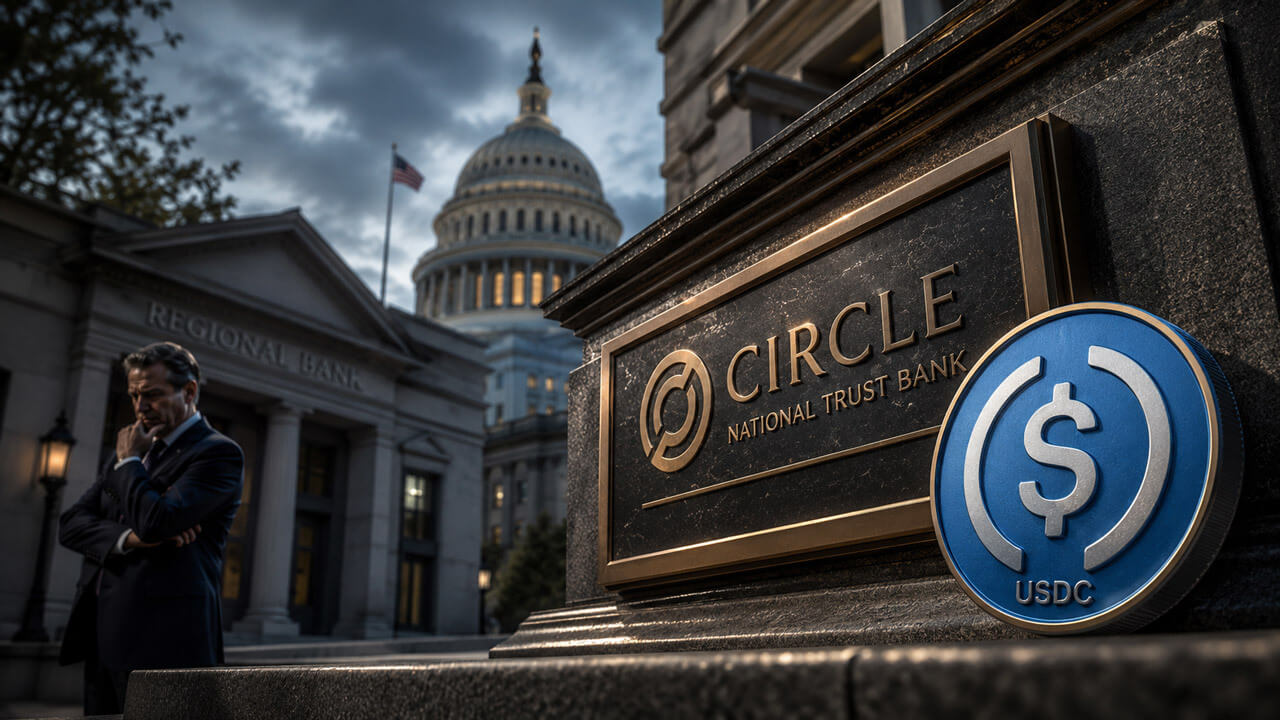
The walls between legacy finance and the digital asset economy just got a lot thinner. Circle, the parent company behind USDC, recently secured green-light status from the Office of the Comptroller of the Currency to operate as a national trust bank. This isn't just another press release about a fintech startup getting a license; this is a fundamental restructuring of how liquidity moves through the American economy.
The End of the Sandbox Era
For years, crypto builders have operated in a gray zone. We were told to innovate, then told we were breaking rules that didn't quite exist yet. By becoming a federal trust bank, Circle is stepping out of that shadow and into the light of federal supervision. It means they aren't just a tech company holding some reserves; they are now a regulated financial institution with a seat at the big table.
This move provides a level of legitimacy that many in the institutional space have been waiting for. If you're a founder building on Top of USDC, your foundation just got upgraded from sand to concrete. But this legitimacy comes with a massive side effect that has the banking lobby breathing down the necks of regulators.
The $500 Billion Drain
Traditional lenders are sounding the alarms. Projections are now circulating that the rise of regulated stablecoins could drain as much as $500 billion from the traditional banking system. Why? Because the value proposition of a bank account is dying.
When you put your money in a commercial bank, they take it, lend it out at 7%, and give you 0.01% in interest. Stablecoins, especially those backed by short-term Treasuries and monitored by the OCC, offer a more efficient alternative. People are realizing they can hold US-denominated value on-chain with instant settlement and 24/7 liquidity, bypassing the antiquated hurdles of the traditional banking stack.
Lenders are worried that as capital migrates to digital dollars like USDC, their own cheap source of funding—your savings account—will vanish. They call it a risk to financial stability. I call it competition finally hitting a stagnant industry.
What This Means for Founders
If you are building in the crypto or AI space, this shift changes your roadmap. We are moving away from the 'casino' phase of stablecoins where people only used them to trade volatile assets. We are entering the 'utility' phase where these assets become the primary rails for global commerce.
- Reduced Counterparty Risk: Building on a regulated federal trust bank's infrastructure reduces the looming threat of a sudden regulatory shutdown.
- Programmable Payments: With federal backing, the friction for non-crypto companies to integrate stablecoins drops significantly.
- Global Settlement: This legitimizes the use of USDC as a settlement layer for international B2B transactions, a multi-trillion dollar market currently choked by the SWIFT system.
However, builders need to stay skeptical. Federal oversight means more reporting, more KYC, and potentially more censorship at the protocol layer. Circle isn't a rebel anymore; they are part of the system. If your project relies on total anonymity, a federally chartered stablecoin is not your friend.
The Power Shift
The traditional banking lobby is powerful, and they won't let $500 billion walk out the door without a fight. We should expect more friction in Washington. The narrative will be shifted to focus on 'consumer protection,' but don't be fooled—this is about protecting the monopoly on deposits.
For the first time, a digital asset firm has the same federal stamp of approval as the banks trying to kill it. This creates a fascinating paradox. The more 'official' stablecoins become, the more they threaten the very institutions that govern them. It is a slow-motion disruption of the most protected industry in the world.
The Takeaway
Circle becoming a federal trust bank is the ultimate signal that stablecoins are now infrastructure, not experiments. This is a massive win for builders who want to bridge the gap between DeFi and the real world. But as half a trillion dollars prepares to leave the legacy system, expect the regulatory pushback to get louder and more desperate.
The banking industry is finally realizing that stablecoins aren't just digital chips for trading tokens; they are a superior technology for holding and moving dollars. That realization is worth about $500 billion in lost deposits, and the banks are terrified.
As a founder, your job is to build for the world where the dollar is a software object. That world just got a lot more real. Keep your eyes on the liquidity, keep your code clean, and don't expect the big banks to go quietly into the night.
Read the original at CryptoSlate →