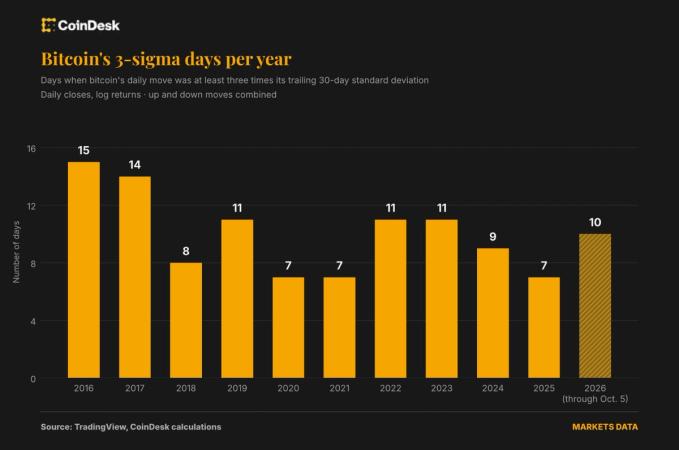
If you look at the standard charts, Bitcoin looks like it is finally growing up. The wild, stomach-churning volatility that defined the early days is supposedly smoothing out. Wall Street is here, the ETFs are flowing, and the narrative says we have entered the era of the 'digital gold' snooze-fest. But if you are building in this space or managing a treasury, the averages are lying to you.
Recent market data from 2026 shows a strange paradox. While the overall annualized volatility has dropped significantly compared to the 2018 era, the frequency of extreme, outlier price swings has actually gone up. We have already seen ten days this year where the price moved with such violence that it broke every standard statistical model. In 2018, a year famous for its brutal volatility, we didn't see this many 'black swan' days.
The Illusion of Stability
For founders, this is a dangerous environment. When we talk about volatility, we usually talk about the average daily move. On that metric, Bitcoin is becoming more predictable. It is behaving more like a tech stock or a high-beta index. This makes the compliance officers and the institutional risk desks happy because they can plug these numbers into their spreadsheets and tell their clients that the asset is maturing.
However, the 'fat tails'—the statistical term for those rare, massive moves—are getting fatter. We are seeing more days where the price drops or spikes by double digits without warning. The overall trend is a slow, steady grind punctuated by moments of absolute chaos. For a builder, this is actually harder to manage than a consistently volatile market. You can prepare for a storm, but it is much harder to prepare for a rogue wave in a calm sea.
Why the Institutional Era is Louder
There was a theory that once the big money arrived, they would provide the liquidity needed to dampen these swings. The logic was simple: more buyers and sellers at every price level would make it harder for the price to move ten percent in an afternoon. That theory is proving to be partially wrong.
What we are seeing instead is a concentration of risk. When large institutions use the same algorithmic triggers and the same leverage providers, their exits are synchronized. Instead of a thousand retail traders making independent, messy decisions, you have a handful of massive entities hitting the 'sell' button at the exact same millisecond. This creates a vacuum of liquidity. The price doesn't just slide; it teleports.
The Builder's Perspective on Risk
If you are running a project or a startup, these findings should change how you handle your capital. Relying on 'average' volatility to set your stop-losses or your runway projections is a recipe for disaster. In 2018, you knew the market was a casino. In 2026, the market looks like a bank, but it still has the trapdoors of a casino.
We need to stop looking at Bitcoin as a monolithic asset that is either 'volatile' or 'stable.' It is becoming an asset of extremes. Most days are boring. The days that aren't boring are becoming more frequent and more destructive than they were eight years ago. This suggests that the underlying plumbing of the crypto market—the way orders are matched and how leverage is cleared—hasn't actually solved the problem of fragility; it has just hidden it behind a curtain of institutional respectability.
The Data Doesn't Lie
The CoinDesk analysis of these ten extreme trading days in 2026 highlights a gap in how we measure success. If success is 'looking like the S&P 500,' then Bitcoin is getting closer. But if success is 'predictability for users,' we are moving backward. For those of us building tools that rely on stable collateral or predictable transaction costs, these ten days represent ten times the system was stressed to its breaking point.
- Standard volatility metrics are masking the frequency of extreme events.
- Institutional participation has changed the nature of crashes, not eliminated them.
- Risk management for 2026 requires accounting for 'flash' events that exceed 2018 levels.
The biggest risk in the current market isn't the daily fluctuations; it's the false sense of security provided by low average volatility while the frequency of extreme outliers continues to climb.
We are in a transitional phase where the old retail-driven cycles are dead, but the new institutional framework is still prone to systemic shocks. As a founder, you have to survive the outliers to enjoy the averages. If your business model assumes Bitcoin has 'settled down,' you are going to get caught when the eleventh extreme day hits, and the data suggests it's coming sooner than you think.
Final Takeaway
The headline numbers say Bitcoin is maturing, but the frequency of extreme price swings tells a different story. Don't let the low annualized volatility fool you into taking on more risk than you can handle. The 'new' Bitcoin is quieter most of the time, but when it screams, it screams louder than ever. Build for the outliers, not the averages.
Read the original at CoinDesk →