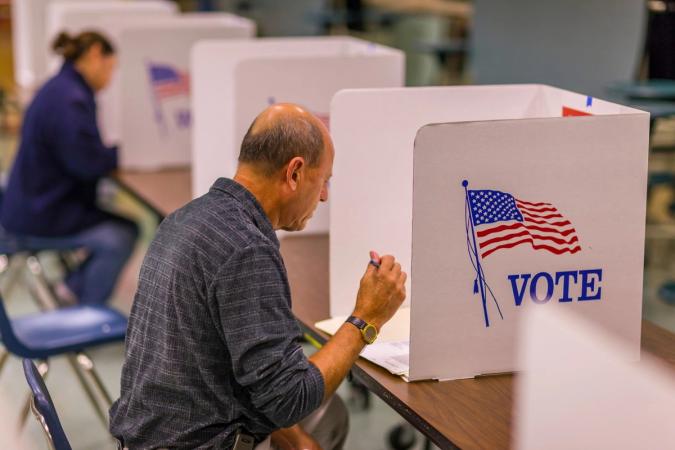
If you look at the options market right now, you will see a massive spike in implied volatility centered right on the upcoming US midterm elections. In the trading world, they call this a volatility curve bump. In the founder world, I call it the distraction tax. While builders are trying to ship code, the market is busy pricing in the possibility of a political flip that could change everything from tax code to SEC enforcement priorities.
The Geometry of Uncertainty
When we talk about a volatility curve, we are looking at how much traders are willing to pay for protection over different time horizons. Usually, this curve is relatively smooth. But right now, there is a distinct hump. People are paying a premium for options that expire just after the election. This tells us two things: nobody knows who is going to win, and everyone is terrified of what happens the day after.
For those of us building in crypto and AI, this volatility is a double-edged sword. On one hand, it creates the kind of price action that brings eyes back to the space. On the other, it makes long-term planning nearly impossible. If you are a founder trying to decide whether to lean into a specific regulatory framework, this midterm bump represents a giant question mark sitting in the middle of your roadmap.
Why This Election Hits Different
In previous cycles, crypto was a niche topic. This time, it is a line item in campaign budgets. We are seeing candidates on both sides of the aisle forced to take a stance on digital asset self-custody and the role of decentralized compute in the AI arms race. The market is reacting to this by pricing in a high-delta event. If the legislative branch shifts, the current regulatory overhang might lift, or it might harden into something even more restrictive.
Traders aren't betting on a 'bullish' or 'bearish' outcome specifically; they are betting on movement. The 'bump' suggests that regardless of who takes the seats, the status quo is leaving. For a startup, that means you need to be agile enough to pivot your legal strategy within 48 hours of the polls closing.
What It Means for the Builders
If you are head-down in a sprint, it is easy to ignore the macro. But you shouldn't. The volatility curve is a reflection of liquidity and risk appetite. When the curve humps like this, venture capital often pauses. LPs want to see how the dust settles before committing to new capital calls. If you are fundraising, realize that the next few weeks are going to be slow, not because your product is bad, but because the people with the money are watching the news.
- Watch the spreads: High volatility means wider spreads. If you are managing a treasury, now is not the time for large, unhedged moves.
- Regulatory drift: A shift in the House or Senate could mean a complete change in who chairs the committees that oversee digital assets.
- Signal vs. Noise: The price of Bitcoin might swing 10% in either direction, but the underlying tech hasn't changed. Don't let the candle colors dictate your engineering velocity.
The Institutional Hedge
This isn't retail panic. This is institutional hedging. The size of the positions creating this curve bump suggests that large desks are protecting their downside. They are buying insurance. As a builder, you should be doing the mental equivalent of buying insurance. Ask yourself: if the regulatory environment gets 20% worse in January, does my business model survive? If the answer is no, you are over-leveraged on political hope.
I’ve seen too many founders wait for a 'favorable' election to fix their problems. Politics is a lagging indicator of cultural shifts. The technology we are building—decentralized networks, autonomous agents, immutable ledgers—is meant to be resilient to these four-year cycles. If your protocol requires a specific person to win an election to be viable, you haven't built a protocol; you've built a political action committee.
The market is currently paying a premium for the unknown. As a founder, your job is to provide the certainty that the market is currently missing.
The Reality Check
We need to be honest about what these midterms represent. They are a temporary roadblock. The volatility curve will flatten out by late November. The bump will disappear, and we will be left with the same technical challenges we had before. The distraction will end, and the work will remain. The smart money is using this bump to hedge. The smart founders are using this time to focus on the things the government can't vote away: code, community, and actual utility.
The takeaway here is simple: don't mistake market turbulence for a lack of progress. The volatility curve is just a graph of human anxiety. It doesn't reflect the quality of your builds or the future of the industry. It just means that for a few weeks, the world is going to be a little noisier than usual. Stay the course, keep your runway clear, and ignore the hump.
Read the original at CoinDesk →