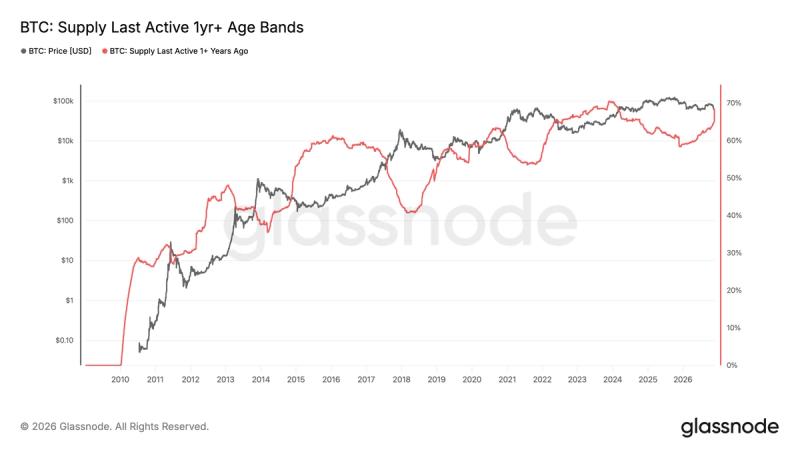
When you look at a Bitcoin chart, your eyes naturally gravitate toward the price candles. Green bars mean people are excited, red bars mean they are selling, and flat bars usually mean the market is bored. But for those of us building in this space, the most interesting data isn't what the price is doing; it's what the coins themselves are doing. Or, more accurately, what they aren't doing.
The Great Sit-Still
Right now, Bitcoin is trading around the $60,000 mark. That is roughly 50% below the recent all-time high, a territory that usually triggers one of two things: a panic-induced fire sale or a massive relief rally. Instead, we are seeing a third, much stranger behavior. The supply is going dormant. More and more BTC is sitting untouched on-chain, refusing to move even as the macro environment shifts around it.
Historically, this kind of behavior isn't just a random fluke. It is a recurring pattern that we typically see during the bottoming phases of a bear market. When the speculative froth has been washed out and the "tourists" have left the building, the remaining holders—the ones who actually believe in the long-term utility of the network—simply stop clicking the sell button. They hunker down. They wait.
Why Builders Should Care
If you are a founder or a developer, you might be wondering why on-chain dormancy matters to your roadmap. It matters because it signals the transition from a speculative market to a foundational one. When coins are moving rapidly between exchanges, the market is driven by noise, leverage, and liquidations. It is a casino. Building a serious product in a casino is difficult because your users are distracted by the flashing lights of 100x leverage.
When supply goes dormant, the noise dies down. The people left holding are the ones who aren't looking for a quick exit. This is the period where real utility starts to take precedence over price action. It is the time to ship features that matter, rather than features that pump. If the market is settling into a floor, it means the foundation you are building on is finally stabilizing.
The Psychology of the Hold
There is a specific kind of mental fatigue that happens when an asset drops 50% and then refuses to recover quickly. Most retail investors can handle a sharp drop if a bounce follows immediately. What they can't handle is the grind. The sideways movement at $60,000 is designed to exhaust the impatient. The fact that dormant supply is rising tells us that the "smart money"—or at least the "stubborn money"—has finished its grieving process and has moved into the accumulation and holding phase.
We have seen this movie before. In previous cycles, when the percentage of supply that hasn't moved in over a year hits these levels, it marks the end of the capitulation. It doesn't mean the price will double tomorrow, but it means the selling pressure from exhausted holders is drying up. There simply aren't many people left who are willing to sell at these levels.
The Risk of the Echo Chamber
As a skeptic, I have to point out the flip side. While dormant supply rising is traditionally a bottom signal, we are in a different macro environment than previous cycles. We have high interest rates, institutional involvement via ETFs, and a global economy that is stuttering. Relying solely on historical on-chain patterns is dangerous. Just because the supply is dormant doesn't mean it can't be woken up by a systemic shock.
However, for a builder, the takeaway remains the same: the volatility that kills startups is currently in a lull. Whether this is the absolute bottom or just a long pit stop, the reduction in active sell-side liquidity gives you room to breathe. Use this time to refine your UX. Use it to talk to the users who are still here, because they are your core audience.
Looking at the Data
The metrics show that coins are moving from "weak hands" to "strong hands," a cliché that happens to be supported by the ledger. The volume of coins that haven't moved in 6 to 12 months is growing. This is the cohort that bought the top or the way down and has decided to ride it out. When this group grows, the liquid supply available on exchanges shrinks. This creates a supply shock potential if demand ever returns in a meaningful way.
But we shouldn't get ahead of ourselves with "moon" talk. The importance of dormant supply isn't about predicting a price pump; it's about confirming market exhaustion. The bears have run out of things to throw, and the bulls are still catching their breath. It is a stalemate, and stalemates are where the best work gets done.
Takeaway for Founders
- Stop watching the $60,000 resistance level and start watching user retention.
- Dormant supply means the market is no longer in a state of active panic; it is in a state of active waiting.
- Assume this price level is the new baseline for your runway calculations, but don't assume a rally is guaranteed.
- The best products are built when the hype is at its lowest. We are approaching that point.
The lesson here is simple: when the money stops moving, the builders need to start moving faster. The distraction of the bull market is gone. The chaos of the crash is fading. What’s left is the technology and the people who actually know how to use it. If you can’t build something useful now, you never will.
Read the original at CoinDesk →