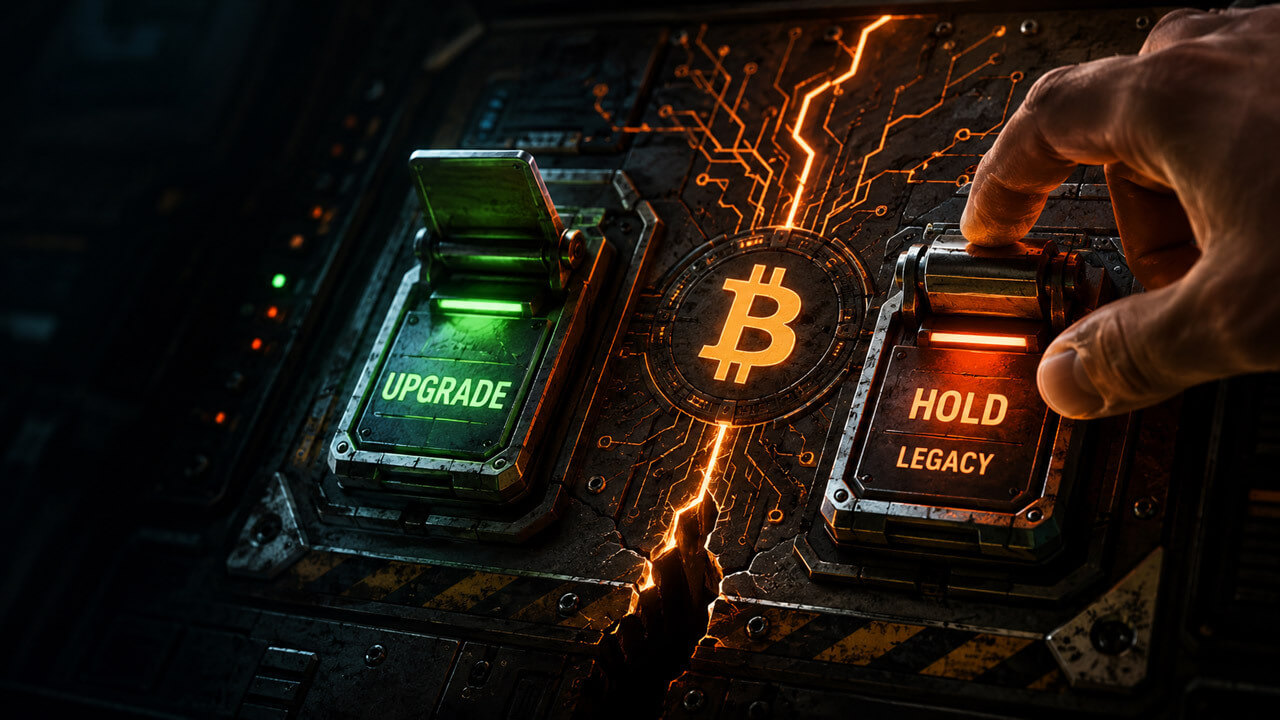
I have spent enough time in the crypto space to know that whenever someone mentions a fork, half the room starts sweating and the other half starts looking for an edge. Bitcoin is currently staring down BIP-110, and it is not just another technical update. It is a fundamental shift in how the network handles specific transaction data, and it is putting every major infrastructure provider on a clock that runs out this August.
The Reality Check on BIP-110
For those who do not live in the GitHub repositories, BIP-110 is focused on a specific type of witness data handling. Right now, the network is in a signaling phase. This is essentially a giant game of poker where miners show their hand to tell the rest of the world if they are ready for a change. Currently, the data shows support hovering around 0.42% since early May. That sounds low, and if you are looking for a reason to ignore it, that number provides an easy excuse. But for builders, ignoring a low signal rate is a rookie mistake.
Low signaling early on is standard. What matters is the August deadline. This is the window where the network decides if it locks in the changes or lets them die on the vine. For exchange operators and wallet developers, this is not about ideology; it is about keeping services online. If the network forks and your node is on the wrong side of the consensus, your users lose access to their funds, and you lose your reputation.
Why Exchanges Are Scrambling
Large exchanges like Coinbase or Binance are not agile. They are giant ships that take a long time to turn. Updating node software across a global architecture requires months of testing. The reason we are seeing alerts from groups like Farside is that the window for a clean transition is closing. If an exchange waits until miners hit a critical mass in July, they are already too late.
I have seen this movie before. In 2017, the block size war felt like a civil war because it was. BIP-110 is less about scaling politics and more about technical efficiency, but the risk of a split remains. If a significant group of miners decides to push this through while a group of large exchanges remains on old software, we get a messy, fragmented market. For a founder building on Bitcoin, that is a nightmare for liquidity and transaction reliability.
The Founder Perspective: Complexity is the Enemy
From where I sit, every protocol upgrade is a double-edged sword. On one hand, you want Bitcoin to evolve. If it stays static, it eventually becomes a relic. On the other hand, every time you touch the consensus layer, you introduce a variable that can break decentralized apps and layer-2 solutions. Builders need to look at BIP-110 not just as an upgrade, but as a maintenance cost. You have to ask yourself: does my stack depend on the current witness structure, and if so, how much effort will it take to pivot if this locks in?
The skepticism comes in when you look at the actual utility of these changes versus the coordination cost. The coordination cost for BIP-110 is high. It requires miners, pools, nodes, and wallets to all move in sync. If the benefit to the end user is marginal, you have to wonder if the risk of a chain split is worth the headache. Right now, the market is voting with silence, hence the sub-1% support. But silence can turn into a roar very quickly in these cycles.
What Happens in August?
August serves as the ultimate filter. If signaling does not ramp up, the BIP basically goes into the trash. If it does ramp up, anyone who hasn't updated their infrastructure will find themselves in a "forced choice" scenario. They either rush an update—which is how bugs get introduced—or they risk being on a minority chain that nobody is trading.
For node operators, the path is clear: update your monitoring tools now. Do not wait for the headlines saying the fork is happening tomorrow. Use the data from BGeometrics and Farside to track the momentum. If that 0.42% starts climbing toward 10% or 20%, the gravity of the fork becomes inescapable.
The STKR Takeaway
Stop looking at Bitcoin as a finished product. It is a living, breathing codebase that requires constant, high-stakes negotiation. BIP-110 is a test of the network's ability to coordinate without a central leader. For builders, the lesson is simple: build for the chain that exists, but keep your infrastructure flexible enough to handle the one that is coming. The August deadline is a hard reminder that in crypto, if you aren't paying attention to the technical signals, you are just waiting to get liquidated by a software update.
The signaling phase isn't just a technical tally; it's a measure of the community's willingness to risk stability for progress. Right now, that willingness is low, but the clock doesn't care about your comfort zone.
If you are running a pool or a wallet, get your devs on this today. If you are an investor, watch the signaling charts, not the price charts. The real power in Bitcoin doesn't lie in the memes; it lies in the nodes.
Read the original at CryptoSlate →