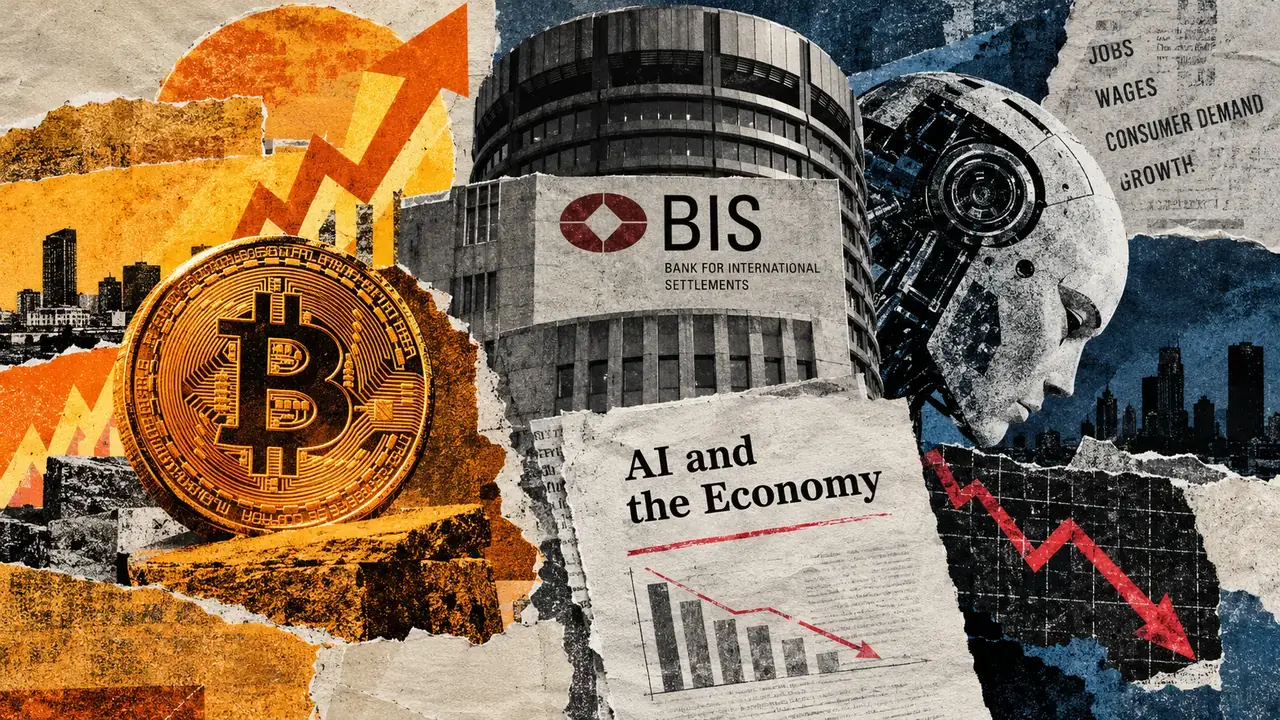
We have reached the point in the cycle where everyone is trying to find the one narrative that makes a permanent bull run inevitable. The latest favorite is the AI-driven productivity boom. The logic seems sound on the surface: AI makes companies hyper-efficient, the economy expands at a breakneck pace, and Bitcoin—being the ultimate scarce asset—absorbs the resulting overflow of capital. It is a clean, mathematical vision of the future that founders love because it rewards optimization.
Bitwise CIO Matt Hougan recently laid out this case, suggesting that almost every macroeconomic road leads back to a higher Bitcoin price. Whether we have inflation, deflation, or a massive tech surge, the argument is that Bitcoin wins. But while the market is focused on the upside of machine efficiency, a new working paper from the Bank for International Settlements (BIS) introduces a variable that most crypto enthusiasts are ignoring: what happens to the people the machines replace?
The Productivity Paradox
For a founder, productivity is the holy grail. If you can replace a ten-person dev shop with three people using AI agents, your margins skyrocket. Multiply that across the entire global economy, and you get a massive spike in wealth. In this scenario, Bitcoin acts as the exit hatch from fiat systems that will inevitably try to print their way into matching that growth. As machines create more value, the value of a hard-capped currency like Bitcoin should, theoretically, go up.
However, the BIS paper highlights a fourth path that isn't as optimistic. It suggests that if AI automates work and drives up the wealth of capital owners while crashing the wages of the working class, we don't just get a rally—we get a structural crisis. When labor's share of the pie shrinks too fast, the consumer base that actually fuels the economy starts to crumble. You can have the most efficient Bitcoin mining operation or the smartest AI agent in the world, but if the broader population is priced out of the economy, the "value" of those assets becomes volatile in a way that charts don't show.
Why Builders Should Care
If you are building in the crypto or AI space, it is easy to stay inside the bubble of technical milestones. We talk about TPS, zero-knowledge proofs, and LLM context windows. We rarely talk about the social contract. The risk here isn't that Bitcoin fails as a technology; it is that the transition to an AI-led economy happens so violently that it breaks the social systems Bitcoin relies on to function.
The BIS model suggests that while AI can lift the economy, the distribution of that lift matters. If the gains are concentrated entirely in the hands of the "machines" and their owners, the resulting inequality could lead to a massive contraction in demand. For Bitcoin, this is a double-edged sword. It serves as a hedge against systemic failure, but it also requires a functioning, liquid global market to maintain its utility as a medium of exchange or a store of value.
The Hidden Danger of Automation
The danger is not the AI itself, but the speed of the transition. In previous industrial revolutions, labor eventually migrated to new types of work. The concern now is that AI moves faster than human retraining cycles. If a significant portion of the workforce sees their income evaporate while the cost of hard assets like Bitcoin climbs, the political pressure to tax, regulate, or even outlaw private wealth increases.
Founders need to realize that Bitcoin does not exist in a vacuum. A rally driven by AI efficiency is only sustainable if there is a way for that wealth to circulate. If the "machines get richer" but the "workers get poorer," the resulting economic environment will be defined by instability rather than growth. We have seen what happens when the gap between the haves and have-nots grows too wide; it usually ends with heavy-handed government intervention that crypto was designed to avoid.
A Founder’s Perspective on Scarcity
We value Bitcoin because it is scarce. In a world where AI can generate infinite content, infinite code, and eventually infinite services, scarcity becomes the most important commodity. That is the core of the bullish thesis. But as a builder, you have to ask: who are you building for? If the goal is to build tools that only serve the top 1% of capital owners while the rest of the world struggles, you are building on a foundation of sand.
The BIS paper is a wake-up call to look past the price action. The real challenge for the next decade of crypto and AI development is creating systems that allow for broader participation. We need protocols that don't just automate humans out of the loop, but provide new ways for humans to capture value in an AI-dominated world. This might mean decentralized physical infrastructure (DePIN), new models for data ownership, or identity protocols that prove a human is behind a transaction.
The Long Game
Bitcoin is likely going higher because the alternative—fiat currency managed by debt-ridden governments—is a sinking ship. But a rally fueled by the displacement of the global workforce is a pyrrhic victory. If the machines own the wealth, the very definition of a "market" starts to change. We could see a world where Bitcoin is incredibly valuable on paper, but the world around it is too fractured to benefit from it.
Don't just watch the charts. Watch the labor statistics. Watch how AI is being integrated into the real economy. If we see productivity gains without a corresponding way for the average person to participate in that growth, the "hidden danger" the BIS mentions will become our primary hurdle. The most successful founders of the next decade won't just be the ones who use AI to cut costs, but the ones who use it to create new types of value that humans can actually participate in.
The goal shouldn't be to build a world where the machines own everything and we just hold the keys. The goal is to use the scarcity of Bitcoin to anchor an economy that is expanding because of AI, not one that is collapsing because of it.
We are at a crossroads. The AI-driven rally is coming, but its longevity depends on whether we are building a playground for the wealthy or a new infrastructure for everyone. The machines are getting smarter and richer. It is up to the builders to make sure the workers aren't left behind in the process.
Read the original at CryptoSlate →