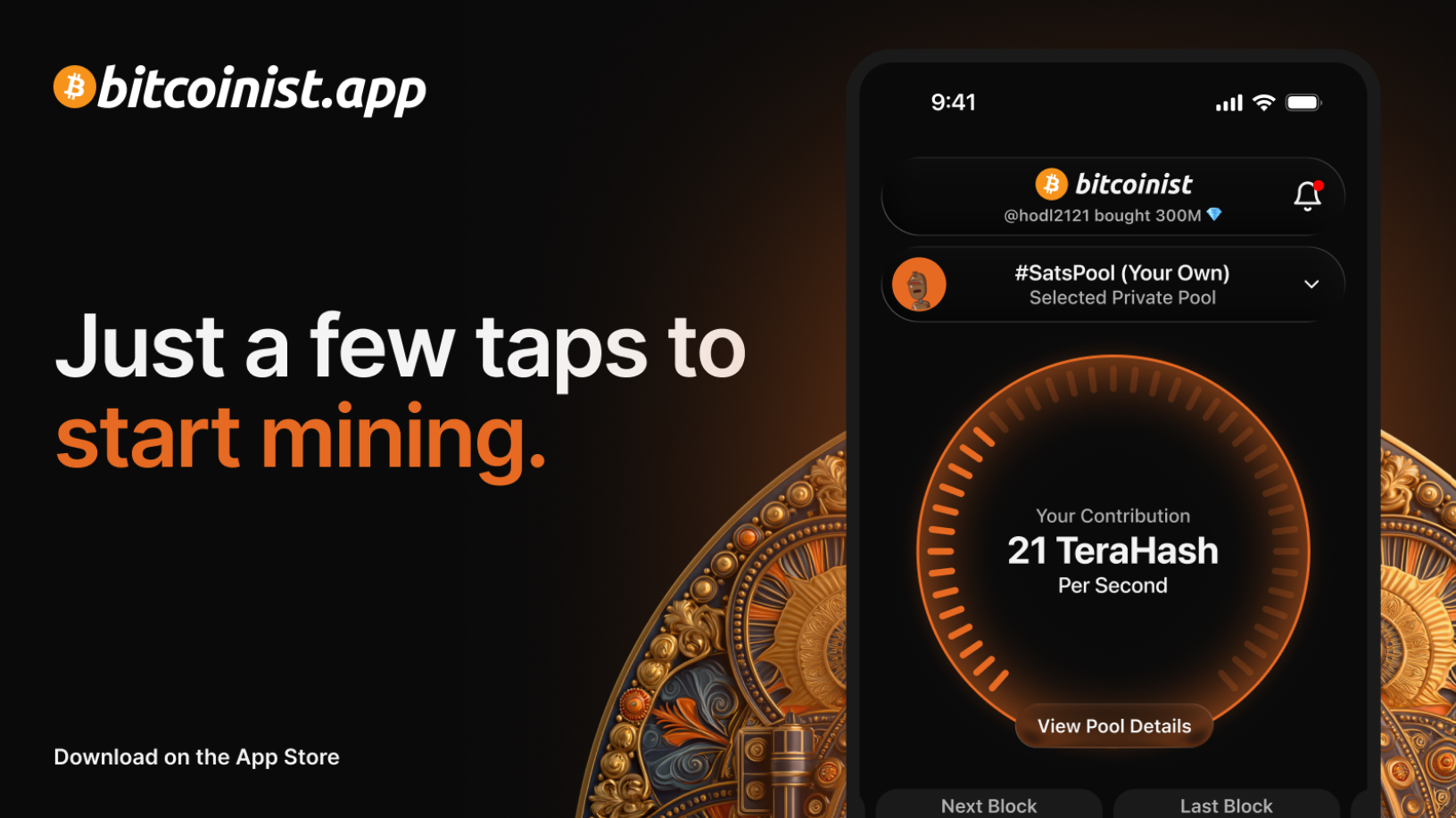
Mainstream crypto adoption is often discussed in terms of ETFs or institutional custody, but for the actual builders, the real goal is keeping the network decentralized at the retail level. A recent move by the application Bitcoinist.App is attempting to push that boundary by introducing private mining pools directly to the Apple App Store. It is a bold move, considering how protective Apple is of its ecosystem and how difficult it is to actually mine Bitcoin on a mobile device with any meaningful result.
The Concept of Social Hashpower
The core proposition here is simple: instead of joining a massive, faceless mining pool where you are just a number in a sea of industrial-scale operations, you can start your own. It is a localized approach to hashpower. The app allows users to create a private pool and invite friends or family to contribute their hardware resources. The goal is to aggregate smaller amounts of computing power to compete against the global network.
From a founder's perspective, this is a clever way to reintroduce the concept of community into an industry that has become increasingly corporate. We have moved from the early days of Cypherpunks mining on laptops to massive warehouses in Texas and Iceland. This app is trying to bring it back to a grassroots level. The payouts are sent directly to wallets controlled by the users, which is a necessary feature for anything claiming to be part of the decentralized movement.
Why Apple is the Real Bottleneck
For those of us who have spent years watching the App Store policies, the mere existence of a mining-related tool is interesting. Apple has historically been very restrictive about what apps can do with a device's processor. They do not want apps burning through battery life or shortening the lifespan of an iPhone's silicon. This is why most mobile mining apps in the past have been either cloud-based scams or very limited simulators.
Building an app that facilitates the logistics of a private pool without violating the developer terms of service requires a delicate balance. It suggests the app is likely acting as a coordination layer rather than trying to hammer the iPhone's CPU to solve hashes directly. For builders, the lesson here is about interface and coordination: the utility is not in the phone's processor, but in its ability to connect people and their disparate hardware.
The Reality Check for Retail Mining
We need to be honest about the math. A private pool consisting of a few iPhones and maybe an old desktop won't stand a chance against a professional mining farm at the current difficulty level. However, the value here isn't necessarily in the immediate profitability. It is in the education and the architecture. By making it easy to see how pools work and how hashpower is aggregated, you lower the barrier to entry for the next generation of node operators.
- Transparency: Users see exactly how their contributions affect the pool.
- Sovereignty: Payouts go to user-controlled wallets, not an exchange account.
- Incentives: Small groups can gamify the process of securing the network.
As a builder, you have to ask if this is a sustainable business model or just a niche tool for enthusiasts. The history of mobile crypto apps is littered with products that were too complicated for the average user and too limited for the pro. If this app can bridge that gap by acting as a management console for external ASIC miners while allowing mobile devices to participate in a minor way, it might find its footing.
The Technical Hurdles of Private Pools
Setting up a mining pool traditionally requires a significant amount of backend infrastructure. You need a stratum server, a database to track shares, and a robust way to handle payouts without getting exploited. Bringing this functionality to an iOS interface is a massive UX challenge. Most people don't want to deal with block headers or difficulty targets; they just want to see a progress bar and a balance.
The skeptic in me knows that the "combinable hashpower" of a few consumer devices is effectively a lottery ticket with astronomical odds. But the founder in me appreciates the attempt to decentralized the pool layer. Currently, a handful of mining pools control a massive percentage of the global hashrate. Anything that encourages small, private clusters is a net positive for the resilience of the network, even if it starts at a tiny scale.
What This Means for the Next Wave of Tools
If you are building in the Bitcoin space right now, you should be looking at how to make complex sovereign actions as simple as a social media app. That is clearly what is being attempted here. We need more apps that handle the heavy lifting of peer-to-peer coordination. Whether it's mining, Lightning Network nodes, or multi-sig setups, the future is tools that look like consumer apps but act like institutional infrastructure.
The real test will be whether this can scale beyond a novelty. If the app allows users to easily point actual ASIC hardware to these private pools via their phones, then we have a game changer for decentralization.
Builders should watch the user feedback on this launch closely. If users are frustrated by the lack of rewards, the app will fail. But if they find value in the private, permissionless nature of the pooling, it opens the door for other private-first infrastructure tools. We are moving away from the "one size fits all" service providers and toward bespoke, private clusters of users who want to opt out of the larger system.
The Bottom Line
The Bitcoinist.App is a gutsy entry into a crowded and regulated market. It challenges the dominance of centralized mining pools by giving the tools of coordination to the everyday user. While I don't expect an iPhone to replace a Bitmain S21 anytime soon, the focus on private pools and direct-to-wallet payouts is exactly the kind of builder-first thinking the industry needs. It moves the conversation from "how do I buy Bitcoin" to "how do I participate in Bitcoin," and that is a shift worth paying attention to.
Read the original at Bitcoin Magazine →