The Ghost of 2013
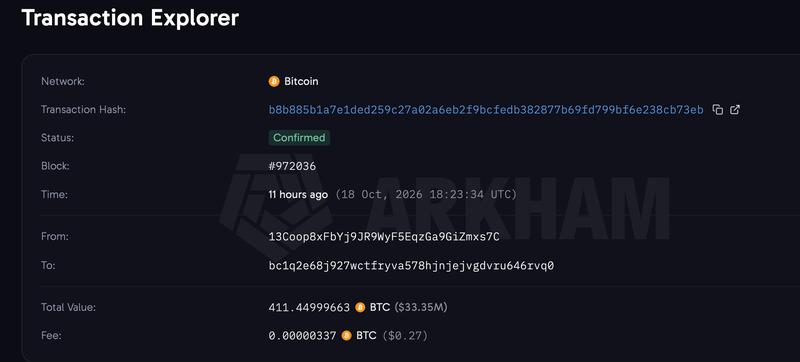
Imagine holding onto a digital asset for over a decade while the world around you changes completely. In 2013, Bitcoin was still a fringe experiment, often dismissed as magic internet money. Back then, a single coin cost about $131. Someone, somewhere, picked up 411 BTC and then simply stopped touching the wallet. For eleven years, that address sat silent, surviving the collapse of Mt. Gox, the China bans, the 2017 bubble, and the FTX contagion.
This week, that wallet woke up. The owner moved the entire balance, now valued at roughly $34 million. While a single whale moving funds isn't necessarily a signal that the sky is falling, it provides a rare window into the mindset of the ultimate HODLers and the shifting liquidity of the market.
The Math of Patience
When you look at the raw numbers, the return on investment here is staggering. We are talking about an increase of over 60,000%. For most founders and builders, we think in terms of quarterly growth or annual milestones. We focus on shipping features and finding product-market fit. But this specific event reminds us that in the crypto space, sometimes the most profitable action is doing absolutely nothing.
However, we shouldn't just look at this as a lottery win. The movement of "Satoshi-era" or early-era coins usually triggers a bit of anxiety in the markets. Why now? Why sell—or at least move to a new address—after eleven years of discipline? It could be a simple case of legacy planning, or it could be a sign that even the most patient investors are starting to look at current price levels as a logical exit point.
Why Builders Should Care
You might wonder why a founder building an AI-integrated dApp should care about a whale from the Silk Road era moving funds. The reason is liquidity and market psychology. These early wallets represent a massive, dormant supply that hangs over the market. When they wake up, they often do so in clusters. We have seen several wallets from the 2010-2014 era come back to life recently.
For those of us building in this space, these movements are a reminder of the volatility we are still tethered to. If several of these whales decided to dump their holdings simultaneously, the resulting slippage could affect the entire ecosystem, including the venture capital appetite for new projects. It is a stark reminder that while we are building sophisticated financial tools and AI agents, we are still operating on a foundation where a few early adopters hold significant sway.
The Psychology of the Exit
Building a company is about creating value. Holding Bitcoin is about preserving it. The tension between these two goals is what defines the current state of the industry. I often talk to founders who are frustrated by the fact that their hard work on a protocol doesn't move the needle as much as a single tweet or a whale movement. That is the reality of the game we are playing.
The person who moved these 411 BTC survived the 2021 peak. They didn't sell when Bitcoin hit $60,000 the first time. They didn't panic when it crashed back to $15,000. Moving funds now suggests a shift in perspective. Perhaps the "moon" they were waiting for has been reached. For builders, this is a signal to keep our treasuries diversified and our expectations grounded. We cannot rely on the perpetual upward movement of the underlying asset to fund our innovations.
Distinguishing Movement from Selling
It is important to note that moving funds to a new wallet does not always mean an immediate market sell-off. Often, these long-term holders are just updating their security protocols. Multisig wallets, hardware migrations, and new custody solutions are much more advanced now than they were in 2013. If you were holding $34 million in a wallet secured by a decade-old private key, you’d probably want to move it to something more modern too.
As builders, we should take a page out of this book regarding security. If you are managing project funds or user assets, the "set it and forget it" mentality only works if your security infrastructure is future-proof. The fact that this whale could successfully access their funds after eleven years is a testament to the robustness of the Bitcoin protocol, but it also serves as a prompt for us to audit our own custody practices.
The Macro Perspective
We are currently in a cycle where AI and crypto are converging, creating a lot of noise. Amidst all the talk of LLMs and decentralized compute, these whale movements serve as a grounding force. They remind us of the original value proposition: a censorship-resistant, finite store of value. The $34 million moved this week didn't require a bank, a broker, or a centralized authority to approve the transfer. It just worked.
For those of us in the trenches building AI agents that transact on-chain, this is the proof of concept. The rails work. The liquidity is there. The wealth is real. Our job is to build the utility that makes this wealth more than just a number on a ledger. We need to create the reasons for that $34 million to be put to work in the decentralized economy rather than just being cashed out for fiat.
Takeaway for the Founder
The takeaway here isn't to go hunting for old wallets. The takeaway is to respect the cycles. We are seeing a generational hand-off of assets. The early believers are starting to distribute their holdings to the next wave of participants, which includes institutional players and the builders who are actually creating use cases.
Don't get distracted by the whale watching, but don't ignore it either. Use it as a reminder to build for the long term. If your project can't survive a decade of silence like that wallet did, you might need to rethink your architecture. Stability and longevity are the ultimate benchmarks in this industry.
Read the original at CoinDesk →