We talk a lot about the technical hurdles of building on top of Bitcoin, but we rarely spend enough time looking at the actual supply velocity of the asset itself. There is a specific kind of math happening right now that should make every founder in the space pause. It is not just that people are buying Bitcoin; it is that the Bitcoin they buy is effectively disappearing.
The Math of Depletion
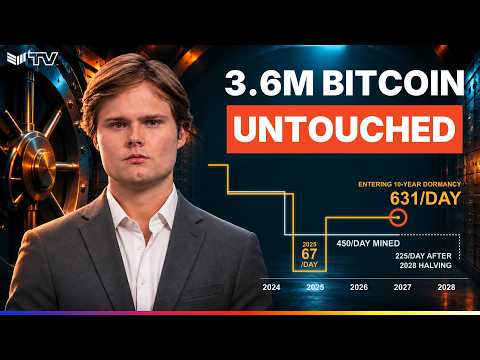
Here is the reality of the current market: Bitcoin miners are currently producing roughly 450 new coins every single day. This is the new supply entering the ecosystem to meet global demand. However, recent data indicates that over the last twelve months, an average of 630 Bitcoin per day has migrated into wallets that have been dormant for at least a decade. That is what we call deep storage.
If you are building a product that relies on liquid markets, this should worry you. We are seeing a net negative supply growth in the active ecosystem. The "new" coins being minted are being outweighed by the "old" coins going into long-term hibernation. This is not just a trend; it is a supply squeeze in slow motion.
Why Deep Storage Matters for Builders
When we look at building decentralized applications or financial protocols, we usually assume a certain level of liquidity. We assume there will always be enough tokens moving around to facilitate trade, collateralize loans, or act as a medium of exchange. But if the underlying asset is being treated exclusively as a digital gold bar buried in a basement, the velocity of money drops to zero.
- Increased Volatility: A thinner liquid supply means that even moderate buys or sells will move the needle significantly. For founders, this means building more robust risk management for your users.
- Collateral Scarcity: If you are building lending platforms, the cost of borrowing Bitcoin will likely increase as holders refuse to move their stacks from cold storage into smart contracts.
- Development Focus: This shift reinforces the idea that Bitcoin is being positioned primarily as a reserve layer, not a transactional one. Your product roadmap should reflect that reality.
I am naturally skeptical of the hyper-bullish narratives that usually accompany these statistics. People like to say this is the ultimate sign of conviction. While that is true, from a founder's perspective, it is also a sign of a stagnant economy. A currency that does not move is a currency that is hard to build a business around.
The Psychological Shift
This move toward deep storage tells us a lot about the current state of the market psyche. We are no longer in the era of the "retail trader" tossing coins around on a whim. The coins moving into these ten-year-plus dormant wallets represent a level of patience that is rare in the crypto world. These are the survivors of multiple cycles who have zero intention of selling for a quick 2X.
As a builder, you have to ask yourself: who are you building for? If the majority of the supply is held by people who have not moved a muscle in ten years, your target audience is a shrinking pool of active participants. You are fighting for the attention of a diminishing supply of liquid assets. This means your product value proposition has to be significantly higher to convince a "HODLer" to actually use their Bitcoin.
The Innovation Gap
The danger here is that Bitcoin becomes a relic of value rather than a tool for innovation. If the trend of vanishing supply continues to outpace production, the cost of acquiring Bitcoin for new users becomes a massive barrier to entry. We risk creating an ecosystem where the early adopters are the only ones who can afford to play.
The biggest threat to a network is not a lack of value, but a lack of utility. If everyone holds and nobody uses, the network effectively stops growing in a meaningful way.
We need to see more efforts in Layer 2 scaling and wrap-solutions that allow people to keep their security while actually participating in the economy. Building on Bitcoin right now feels like trying to build a city on top of a mountain of gold that nobody wants to dig up. It looks great from a distance, but it is incredibly difficult to get the resources you need to actually construct anything.
What This Means for the Future
For those of us in the trenches building these companies, this data is a double-edged sword. On one hand, scarcity is a great marketing tool. It drives interest and increases the valuation of the underlying asset. On the other hand, it makes the job of a developer much harder. You are essentially competing against the "do nothing" strategy, which, as the data shows, is winning by 180 coins a day.
My advice for founders is to stop assuming that liquidity will always be there. Start designing systems that can function in a low-velocity environment. Look at how you can bridge that gap between deep storage and active utility without compromising the security that makes people want to hold Bitcoin in the first place.
Takeaway for the Ecosystem
The fact that Bitcoin is vanishing faster than it is being made is a testament to its staying power, but it is also a warning for the builders. We are moving into a phase where Bitcoin is a silent asset. If we want to build a real economy, we have to find ways to make that value work without forcing people to sell. The future belongs to those who can unlock the utility of dormant capital.
Read the original at Bitcoin Magazine →