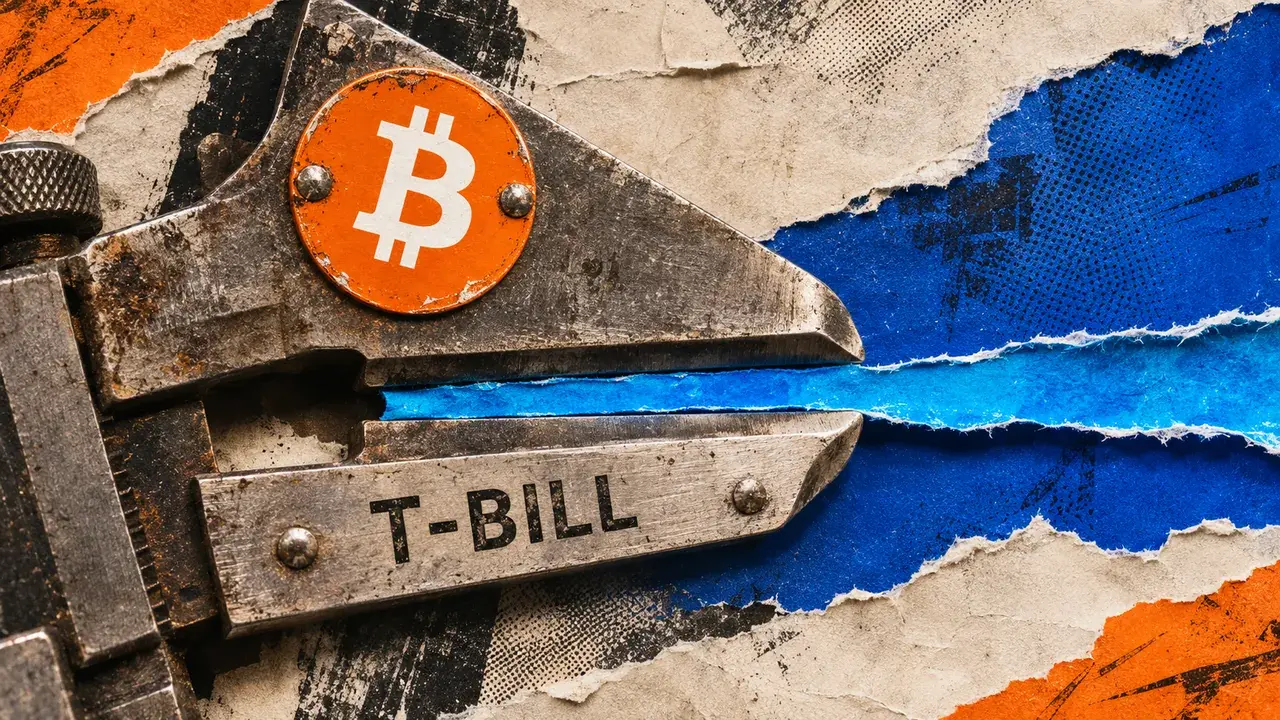
We have spent the last decade obsessed with the spot price of Bitcoin. For most builders and founders, the volatility is either a feature or a bug, depending on whether you are raising capital or trying to pay payroll. But there is a shift happening in the plumbing of the market that has nothing to do with HODLing or moon missions. It is the rise of the Bitcoin carry trade.
New data suggests that by 2027, the return on Bitcoin basis trades could consistently outperform U.S. Treasury bills. This is significant because it marks the transition of crypto from a purely speculative asset class into a sophisticated yield engine. For those of us building in this space, it means the liquidity environment is about to get much deeper and more predictable, even if the price of BTC goes sideways for a year.
The Mechanics of the Neutral Trade
To understand why this matters for the ecosystem, you have to look at the funding rates. In a typical carry trade, an investor buys spot Bitcoin and simultaneously sells a futures contract. This is a delta-neutral position. They do not care if the price goes to zero or a million; they are simply harvesting the difference between the spot price and the futures premium.
We saw 67 consecutive days of negative funding in 2026, a period where the market was essentially paying people to take long positions. It was a bleak time for yield seekers. However, the tide is turning. As leverage returns to the market, the demand for futures is pushing that premium back up. Analysts are now projecting that this spread will widen enough to beat the risk-free rate offered by the government.
Why Builders Should Care About Basis
If you are a founder, you might wonder why the spread between spot and futures matters to your dApp or your L2 scaling solution. The answer is capital stability. When Bitcoin can produce a reliable, low-risk yield that beats the dollar, it attracts the kind of institutional liquidity that does not panic-sell when a tweet goes viral.
- Lower Cost of Capital: As carry trades become more efficient, the cost of hedging decreases for businesses that hold crypto on their balance sheets.
- Market Depth: Higher volumes in the futures market mean less slippage for large moves, creating a smoother environment for DeFi protocols.
- Product Opportunities: There is a massive gap in the market for tools that allow smaller players to access these institutional-grade carry yields automatically.
The 2027 Outlook: Treasuries vs. Code
Treasury bills have long been the gold standard for sitting on cash. But the macro environment is changing. If Bitcoin funding rates stabilize as predicted, we are looking at a scenario where code-based yield outpaces sovereign debt yield. This is not about "flipping" the dollar; it is about providing a more efficient utility for idle capital.
The skepticism comes in when you look at the volatility of the funding rates themselves. Unlike a T-bill, which is backed by the full faith and credit of the government, the Bitcoin carry trade is backed by the demand for leverage. If the market goes quiet, the yield disappears. However, the trend line suggests that as the asset class matures, the periods of negative funding are becoming outliers rather than the norm.
The Risk of the Leverage Cycle
We have to be honest about the downside. The only reason the carry trade beats Treasuries is that someone, somewhere, is willing to pay a high price to go long with leverage. This is a market fueled by appetite. If we see a massive deleveraging event, the basis collapses. We have seen this movie before, and it usually ends with a lot of liquidations.
The carry trade is a bet on the persistence of human greed. As long as people want to borrow money to bet on Bitcoin going up, there will be a yield for those who provide the liquidity.
For founders, the takeaway is to watch the funding rates as a barometer for market health. When the basis is high, the market is optimistic and liquid. When it is negative, like it was for that long stretch in 2026, it is time to hunker down and focus on core development rather than market-driven growth.
Infrastructure for the Next Phase
What we need now are better primitives to democratize this. Currently, the carry trade is the playground of hedge funds and sophisticated desks. To truly reach the potential projected for 2027, we need automated vaults and clear regulatory frameworks that allow startups to treasury manage their funds using these strategies without needing a PhD in derivatives.
The goal is to reach a point where a crypto-native company can earn a competitive yield on its treasury without taking directional price risk. That is the missing piece of the puzzle for the "builder-first" economy. If we can beat T-bills while staying within our own ecosystem, we have truly decoupled from the traditional financial system's gatekeepers.
Final Thoughts for the Founder
Do not get distracted by the daily price candles. The real story is the professionalization of the yield curve. If 2027 is the year Bitcoin yield beats the government, then 2024 and 2025 are the years we should be building the pipes to handle that flow. The opportunity is not just in the asset itself, but in the arbitrage of its maturity.
Read the original at CryptoSlate →