The Great Uncoupling That Wasn't
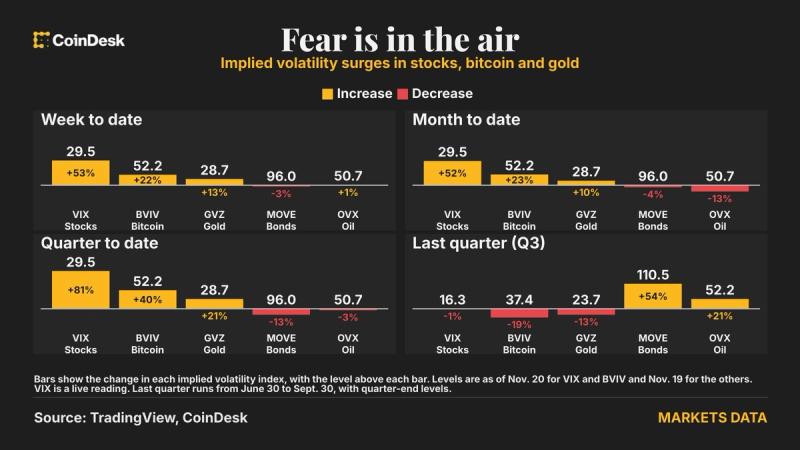
For months, the narrative in the builder space was that we had finally escaped the gravitational pull of traditional finance. The idea was that Bitcoin would act as the ultimate hedge while tech stocks found their footing in an AI-driven renaissance. But looking at the current volatility gauges for late November 2026, that theory is being put to a very expensive test.
We are seeing a rare alignment where Bitcoin, equities, and even gold are twitching in unison. Normally, when the VIX spikes in the stock market, you expect to see capital rotate into perceived safe havens. Instead, everything is vibrating. For those of us building in crypto and AI, this isn't just a chart problem; it is a sentiment problem that directly impacts our ability to raise, hire, and plan for 2027.
Understanding the Volatility Spike
The numbers coming out of the options markets right now are loud. Traders are paying massive premiums for downside protection. This isn't just typical end-of-quarter rebalancing. It reflects a deep-seated nervousness about global liquidity. In the crypto markets specifically, the implied volatility for Bitcoin has jumped significantly, suggesting that the era of stable, upward grinding might be pausing for a more violent period of price discovery.
As a founder, I look at volatility differently than a day trader does. A trader sees an opportunity for a quick flip; a founder sees a potential freeze in the venture capital pipeline. When the LPs who fund the VCs see their gold and stock portfolios swinging by three or four percent a day, they tend to stop taking calls about seed rounds for decentralized compute protocols.
The Gold Signal
Perhaps the most telling part of this current market shift is gold. Usually, gold is the boring uncle at the Thanksgiving table—reliable, slow, and predictable. When gold starts showing the kind of intraday swings we are seeing now, it means the big money is genuinely confused. They aren't sure if we are heading for a deflationary crash or another inflationary spike.
This confusion is dangerous for builders. It creates a "wait and see" atmosphere. If you are currently in the middle of a fundraise, you’ve likely noticed that due diligence is taking longer. Partners are asking more questions about your runway and your plan for a low-liquidity environment. This is the direct result of the volatility gauges we are seeing today.
What This Means for the Build
If you are building in the AI or crypto space, the volatility in the underlying assets (like Bitcoin) or the infrastructure stocks (like Nvidia or the big cloud providers) acts as a distraction. You have to be disciplined enough to ignore the noise while being pragmatic enough to account for the risk. The worst thing a founder can do right now is assume that the cheap capital of the last eighteen months is a permanent fixture.
We have to look at our burn rates. If your business model relies on the price of a specific token staying above a certain threshold to keep the lights on, you aren't running a tech company; you're running a levered bet. This volatility spike is a reminder to decouple your operational reality from the market's mood swings.
- Re-evaluate your treasury management. If you are holding 100% of your runway in volatile assets, you are asking for trouble.
- Watch the correlation. When Bitcoin and stocks move together during a dump, it means the "macro" is in charge, not the technology.
- Prepare for a slower sales cycle. Corporate buyers tighten their belts when the VIX stays elevated.
The Skeptic’s View on "Safe Havens"
I’ve always been skeptical of the term safe haven. In a true liquidity crunch, there is no such thing. Everything gets sold to cover margins elsewhere. That is exactly what the current surge in volatility gauges is hinting at. People aren't selling Bitcoin because they stopped believing in decentralization; they are selling it because their tech stock positions are underwater and they need the cash.
For those of us in the trenches, this is actually a productive period, even if it feels painful. High volatility shakes out the tourists. The "AI founders" who were just wrappers for a generic API and the "crypto builders" who were just chasing a pump tend to disappear when the markets get choppy. It leaves more room for those of us who are actually solving hard problems in distributed systems and machine learning.
The Founder Strategy
My advice to the founders reading STKR News is simple: don't try to time this. You can't outguess the options traders who are driving these volatility indexes. Instead, focus on your unit economics. Can you survive if Bitcoin drops another 20%? Can you survive if the Nasdaq takes a 10% hit and your lead investor gets cold feet?
Real resilience isn't about predicting the storm; it is about building a ship that doesn't care if it rains.
We are entering a phase where the market is demanding proof of utility over proof of hype. The surging volatility is a signal that the easy gains are over. Now, the real work begins.
The Takeaway
The simultaneous rise in volatility across Bitcoin, stocks, and gold is a rare warning sign of systemic stress. For builders, this is a prompt to secure your runway, tighten your operations, and focus on building products that provide value regardless of the macro environment. The noise is going to get louder before it gets quieter. Stay focused on the code and the customers, and let the traders worry about the VIX.
Read the original at CoinDesk →