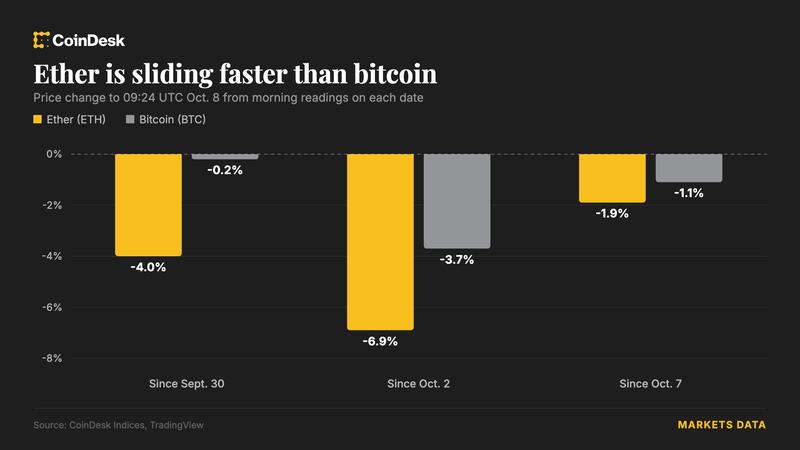
Markets are doing what markets do. After a stretch of relentless upward pressure, Bitcoin has dipped back under the $83,000 mark. While the price action has the usual suspects on social media calling for a crash, the real conversation is happening in the research trenches. Specifically, a recent warning from Ethereum researcher Justin Drake about 'bunker mode' has the developer community split right down the middle.
The Threat of AI-Driven Cryptanalysis
The core of the debate isn't about the next Federal Reserve meeting or spot ETF flows. It is about the fundamental security of every wallet currently holding assets. Drake’s premise is simple: the convergence of specialized AI and potential quantum leaps in computing could render current elliptic curve cryptography obsolete sooner than we anticipated. He suggested that Ethereum, and by extension the broader crypto space, needs to prepare for a state of emergency.
For those of us building in this space, this isn't just academic theory. Most of our current security models rely on the assumption that certain mathematical problems are too hard for computers to solve in a reasonable timeframe. If AI can optimize the search for private keys or find shortcuts in the math we rely on, the entire house of cards falls down. Drake is essentially calling for a proactive migration to post-quantum cryptography, or what he terms a bunker mode.
Why the Community is Divided
Predictably, the reaction has been polarized. On one side, you have the pragmatists who believe that talking about existential threats during a market correction is unnecessary fear-mongering. They argue that we are years, if not decades, away from AI being able to brute-force a seed phrase or crack a signature. They see this as a distraction from scaling and user experience hurdles that are more immediate.
On the other side, you have the security-first crowd. They understand that you cannot simply flip a switch to update the cryptography of a global, decentralized ledger. It takes years of testing and coordination. If we wait until the first major wallet is drained by an AI-assisted attack, it is already too late. The trust in the system would be vaporized instantly.
- The Skeptic's View: AI is good at patterns, not necessarily breaking math that requires raw compute power we don't have yet.
- The Builder's View: We need to build 'crypto-agility' into our protocols now so we can swap out signature schemes later.
- The Market's View: Uncertainty leads to selling, hence the dip below $83,000.
What This Means for Founders
If you are running a startup or building a new protocol, you should be paying attention to this debate, even if you don't care about the price of ETH. The takeaway here is the importance of technical debt. If you build your entire stack on a specific cryptographic standard without a plan for migration, you are building on a foundation that has a known expiration date.
We have seen this movie before in traditional cybersecurity. The transition from SHA-1 to more secure hashing algorithms took far longer than anyone expected because too many systems were hard-coded. In crypto, where the code is the law and the assets are sovereign, that kind of delay is fatal.
The worst time to fix your roof is during a thunderstorm. The worst time to upgrade your protocol's security is after the first exploit.
A Reality Check on the $83,000 Level
Let's look at the price action in the context of this news. Bitcoin dropping below $83,000 is a healthy correction in a macro bull trend. It is easy to blame the 'bunker mode' talk for the dip, but the reality is that markets need to breathe. However, the timing of these research warnings often coincides with periods of high tension. When people are already nervous about their gains, talk of 'existential cryptographic failure' gives them a reason to click the sell button.
From a founder's perspective, I don't see this as a reason to panic. I see it as a design requirement. If you are pitching a VCs or building a product, you should be able to answer how your project handles a future where current ECDSA signatures are no longer enough. Being prepared for the worst-case scenario isn't being a doomer; it is being a professional.
The Path Forward
The divide in the community will likely persist until we see actual proofs-of-concept for AI-driven cryptanalysis. Until then, we are in a period of theoretical warfare. The Ethereum researchers are doing their jobs by looking five years down the road. The traders are doing their jobs by reacting to the immediate sentiment. As a builder, your job is to stay somewhere in the middle.
Don't let the headlines distract you from the work, but don't ignore the technical warnings from the people who know the math better than you do. We are moving into an era where AI isn't just a tool for writing copy or generating art; it is a tool for probing every weakness in our digital infrastructure.
The current price dip is a blip. The shift toward post-quantum security is the actual story. Whether or not we enter bunker mode today, the necessity of building adaptable systems has never been clearer. Keep your heads down, keep building, and maybe start looking into what a migration plan looks like for your own stack. It is better to have it and not need it than to watch your users' funds disappear because you thought the math was invincible.
Read the original at CoinDesk →