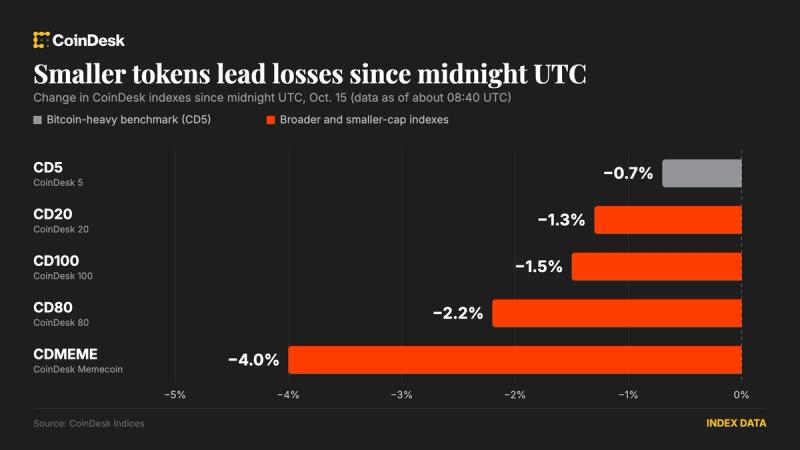
Market volatility is the great filter for builders. When South Korea’s Kospi index took an 8% dive, it wasn’t just a regional headache. It sent a shockwave through the risk-asset landscape, dragging most of the altcoin market down with it. The CoinDesk 80 and the broader CoinDesk 100 looked like a sea of red, with only a handful of outliers managing to stay afloat.
The $80,000 Line in the Sand
Despite the carnage elsewhere, Bitcoin is holding its ground just above $80,000. For anyone who has been in this space for more than one cycle, this price level is more than just a psychological milestone. It is a signal of maturity. Usually, when traditional equities in Asia melt down, Bitcoin follows suit in a race to the bottom. Seeing it trade sideways while altcoins get haircut suggests that the narrative of Bitcoin as a distinct asset class is actually sticking.
As a founder, I look at this and see a flight to quality. The capital isn't necessarily exiting crypto; it’s consolidating into the one asset that has institutional buy-in and a clear regulatory runway. The altcoin flush-out, while painful for treasury diversifications, is a necessary periodic cleaning of the pipes.
Why the Kospi Matters to You
You might wonder why a stock index in Seoul should dictate the roadmap of a Web3 startup in Austin or Berlin. The reality is that liquidity is global. South Korea has long been a massive hub for retail crypto trading and high-frequency volume. When their domestic equity market cratered by 8%, it triggered margin calls and de-risking across the board. Liquidity providers pulled back, and the first things to get sold were the high-beta altcoins.
This is a reminder that we don't build in a vacuum. Your project’s token price or your ability to raise a bridge round is tethered to the global macroeconomic climate, whether you like it or not. If global markets are fearful, the appetite for experimental tech drops instantly.
The Founder’s Perspective on Volatility
I’ve always told my teams that you can't build a product on top of a price chart. If your entire business model relies on your token being up 20% every month, you don't have a business; you have a leveraged bet. The current market action should serve as a wake-up call to focus on utility and sustainable unit economics.
When Bitcoin stays steady while the rest of the market wobbles, it tells me that the 'smart money' is bored of the hype. They want assets with proven liquidity. For builders, this means the bar for launching new tokens just got higher. You are no longer competing against other startups; you are competing against the perceived safety of Bitcoin and the yield of traditional finance.
Survival Tactics for the Current Phase
- Manage Your Runway: If your treasury is sitting in altcoins that just dropped 5% while Bitcoin stayed flat, you are losing purchasing power. Professionalize your treasury management.
- Ignore the Noise: An 8% drop in the Kospi is a headline, but it isn't a fundamental shift in blockchain technology. Keep shipping.
- Watch the Correlations: We are seeing a decoupling. Bitcoin is behaving differently than the rest of the CoinDesk 100. Pay attention to which assets are actually holding value when the wind blows.
The Reality Check
Let’s be honest: most of the projects in the CoinDesk 100 that fell today probably deserved to. The market has a way of punishing projects that lack real-world traction during times of macro stress. The fact that all but six members of that index declined shows how correlated the 'tail' of the market still is. Most of these assets are still just 'Bitcoin with more risk.'
If you are building an AI-integrated dApp or a new Layer 2, your goal should be to break that correlation. You want to be one of the six that stays green when the world turns red. That only happens if you have users who need your product regardless of what the South Korean stock market does.
The market isn't irrational; it is just impatient. It rewards stability and punishes uncertainty. Bitcoin is currently the only thing in this industry offering the former.
Looking Ahead
We are going to see more days like this. As AI and crypto continue to merge, the complexity of these market movements will only increase. We are entering an era where software-driven trading bots react to geopolitical news faster than a human can read a headline. This creates 'flash' events that can wipe out a startup’s capital if they aren't careful.
Bitcoin staying above $80,000 is a win for the industry, but it’s a hollow victory if the rest of the ecosystem is bleeding out. My takeaway for builders is simple: use this period of Bitcoin stability to harden your infrastructure. If the 'Digital Gold' narrative is holding, the 'Digital Utility' narrative needs to catch up.
Stop watching the 1-minute candles. Start watching the macro trends. The rout in Asia isn't an ending; it’s a stress test. Make sure your project is built to survive the next one.
Read the original at CoinDesk →