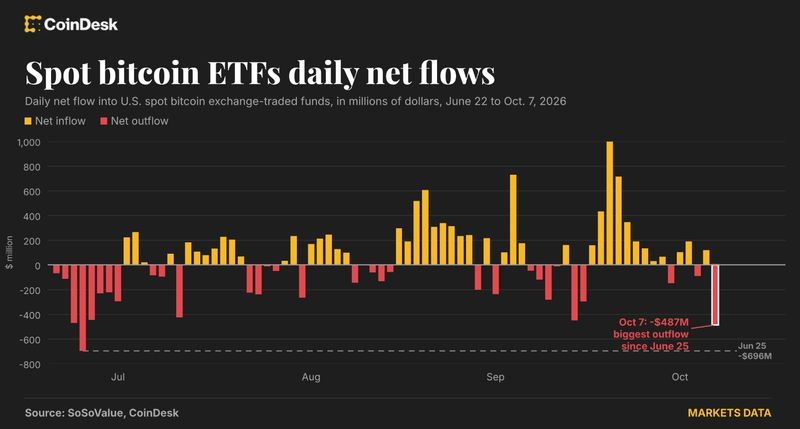
We have reached the part of the cycle where the spreadsheets are winning over the memes. For months, the narrative in the crypto space was dominated by the entry of the institutions. We were told that the Bitcoin ETFs were the final boss of adoption, the gateway for the so-called smart money to finally stabilize the market. But the recent data shows a different story: a mass exodus that marks the largest outflow of capital we have seen in several months.
For those of us building in this space, this is not a surprise, but it is a necessary reality check. The institutional wall of money is not a permanent fixture; it is a guest that leaves the moment the room gets too loud or the air gets too thin. When these funds see red, they do not hold for the technology or the vision of a decentralized future. They sell because their risk parameters tell them to sell. That is exactly what we are seeing right now.
The ETF honeymoon is officially over
When the ETFs launched, the hype was focused on accessibility. Anyone with a brokerage account could suddenly get exposure to Bitcoin without managing private keys or dealing with exchange hacks. That accessibility worked both ways. It made it easier to get in, but it made it even easier to get out. The friction that used to keep retail investors locked in during a dip—things like transfer delays or the sheer complexity of moving funds—does not exist for the ETF buyer.
The current rush for the exit suggests that the new class of Bitcoin holders views the asset not as a long-term hedge against fiat debasement, but as just another high-beta tech play. When the broader markets get shaky, they dump Bitcoin to cover their positions elsewhere. This creates a feedback loop that builders need to pay attention to. We are no longer operating in a vacuum where crypto moves on its own internal logic.
What this means for the founder perspective
If you are building a product or a protocol right now, you have to stop relying on the idea that ETF inflows will provide a floor for the market. Relying on institutional sentiment is like building a house on sand. It looks great when the tide is out, but the moment the weather changes, your foundation disappears. The exit of these investors is a signal that the market is searching for actual utility beyond just price appreciation.
Founders need to look at this outflow as a clearing of the decks. The noise is being filtered out. The people leaving are the ones who were here for a quick trade or a quarterly rebalance. The people staying are the ones who understand that the underlying technology is still solving the same problems it was solving when Bitcoin was at twenty thousand dollars. The builders who survive this period are the ones who focus on shipping features rather than watching the ticker.
The danger of the institutional narrative
We spent the last two years chasing institutional validation. We wanted the big banks and the asset managers to tell us we were right. Now that they are here, we are seeing the downside of that validation. Their presence has tied Bitcoin closer to the traditional financial system than ever before. This correlation is a double-edged sword. It brings liquidity, but it also brings the volatility of the legacy world into our backyard.
As builders, our job is to create systems that do not depend on the whims of a hedge fund manager in New York. We should be focused on censorship resistance, self-custody solutions, and decentralized infrastructure that works regardless of whether BlackRock is buying or selling. The exit we are seeing right now is a reminder that the institutions are not our saviors; they are just participants.
Building for the long-term cycle
This rush for the exit is likely to continue until we hit a new equilibrium. That is fine. In fact, it is healthy. Every time the market flushes out the speculators, the industry gets a chance to refocus. If your roadmap was based on the assumption that Bitcoin would hit a new all-time high every month because of ETF demand, you need to rewrite your roadmap. You need to build for a world where capital is expensive and attention is scarce.
We are entering a phase where the market will demand proof of work from us, not just in the mining sense, but in the product sense. Does your protocol actually solve a problem? Does your AI integration offer a real efficiency gain, or is it just a buzzword to attract a seed round? The institutional exit is a signal that the easy money has been made, and the hard work of building sustainable ecosystems is beginning.
The skeptical take on the recovery
Do not expect a V-shaped recovery driven by the same group that just left. The institutional investors who are heading for the exits now will wait for a significant period of stability before they consider coming back. They have seen the volatility, and they have realized that Bitcoin is not the sleepy, gold-like asset they were promised by the marketing materials. They will return, but it will be on their terms and at their pace.
For those of us in the trenches, this is the time to ignore the headlines about outflows and focus on the commits. The best time to build is when the tourists are leaving. The noise levels are dropping, and the real signals are starting to emerge again. We have seen this movie before, and we know how it ends: the builders who stay focused during the exodus are the ones who lead the next charge.
The takeaway for builders
The lesson here is simple: stop checking the ETF flow data. It is a lagging indicator of institutional fear, not a leading indicator of technological progress. Your goal should be to build something so useful that it does not matter what the price of Bitcoin is. If you can create value in a down market while the institutions are running for the hills, you will be unstoppable when they eventually come crawling back.
The institutional wall of money is not a permanent fixture; it is a guest that leaves the moment the room gets too loud or the air gets too thin.
Stick to the fundamentals. Focus on the user experience. Make sure your business model works without needing a bull market to subsidize it. The exit of the ETF investors is a gift to the serious founder because it clears out the competition that was only here for the hype. Now, let's get back to work.
Read the original at CoinDesk →