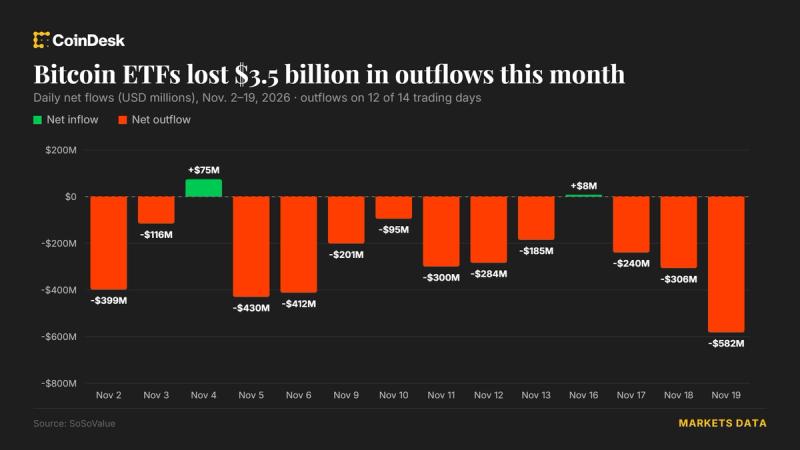
We are seeing something we haven't seen in over two years. BlackRock’s spot bitcoin ETF, the vehicle that was supposed to represent the indestructible 'institutional floor' for this asset class, just recorded its largest single-day outflow since it launched. At the same time, Bitcoin has notched its third consecutive day in the red, dragged down by a broader retreat in Asian technology stocks.
For those of us building in this space, this isn't a reason to panic, but it is a necessary reality check. The narrative that ETFs would decouple crypto from the whims of traditional equity markets is officially dead. If you are building a product based on the assumption that Bitcoin is 'digital gold' that moves inversely to the Nasdaq or the Nikkei, you need to revisit your roadmap.
The Institutional Liquidity Trap
When the spot ETFs were approved, the consensus was that we had finally graduated. We thought the 'smart money' would provide a buffer against the volatility of the retail-driven markets. What we are seeing now is the opposite. The ETF structure has turned Bitcoin into just another line item on a risk-on/risk-off balance sheet for fund managers.
When tech shares in Asia slide, global managers look for liquidity. They don't sell their most illiquid assets first; they sell what they can move quickly. Bitcoin, thanks to these ETFs, is now incredibly liquid. The record outflow from BlackRock isn't necessarily a statement on Bitcoin’s long-term value. It’s a statement on the immediate need for cash in a trembling global market.
The ETF was supposed to be a shield. Instead, it has become a high-speed exit ramp for traditional finance.
The Asian Tech Connection
The correlation between crypto and Asian tech shares is becoming harder to ignore. Markets in Tokyo and Seoul often act as a lead indicator for how the U.S. session will open. When investors there start dumping semiconductor stocks and hardware manufacturers, it signals a lack of confidence in the short-term growth cycle. Because Bitcoin is currently traded as a high-beta play on technology, it gets caught in the crossfire.
Builders need to understand that we are operating in a global macro environment where Bitcoin is still a 'proxy for risk.' Until we see widespread utility that isn't dependent on price speculation, we are going to be tethered to the performance of tech giants. If the chipmakers are struggling, your DeFi protocol or L2 is likely going to feel the squeeze on the liquidity side.
What This Means for Founders
If you’re running a startup in this space, three days of red and record outflows should change how you think about your runway and your product-market fit. We’ve had a long run of 'up only' sentiment fueled by the ETF hype. That hype cycle has hit a ceiling.
- Stop relying on the 'Institutional Savior' narrative: The institutions are here, but they are flighty. They will leave the room the moment the macro weather turns cold. Build for users, not for fund inflows.
- Watch the global correlations: If your project’s treasury is 100% in BTC or ETH, you are effectively a levered bet on global tech sentiment. Diversification isn't just for investors; it's for survival.
- Focus on non-speculative utility: The only way to break the correlation with tech shares is to create value that exists regardless of the token price. If your app only works when gas is high and the market is pumping, you don't have a business; you have a carnival game.
The Silver Lining
I’ve always said that the best building happens when the noise dies down. The 'tourist' capital leaving the BlackRock ETF is actually a good thing for the long-term health of the ecosystem. We need the leverage to be flushed out. We need the people who bought Bitcoin because it was a ticker symbol on a brokerage app to realize that this is a volatile, emerging technology—not a savings account.
The current slide is a reminder that Bitcoin is still early. It’s still being figured out by the biggest players in the world. They don't know where it fits yet, so they treat it like a tech stock. Our job as builders is to prove them wrong by creating the infrastructure that makes Bitcoin indispensable, regardless of what the Asian markets are doing on a Tuesday morning.
The Bottom Line
Don't get distracted by the three-day candle or the outflow numbers. These are symptoms of a market trying to find its footing in a shaky global economy. The volatility is the point. If it weren't volatile, the opportunity wouldn't be this large. Keep your head down, watch your burn, and remember that the institutions are guests in this house—they don't own it yet.
Read the original at CoinDesk →