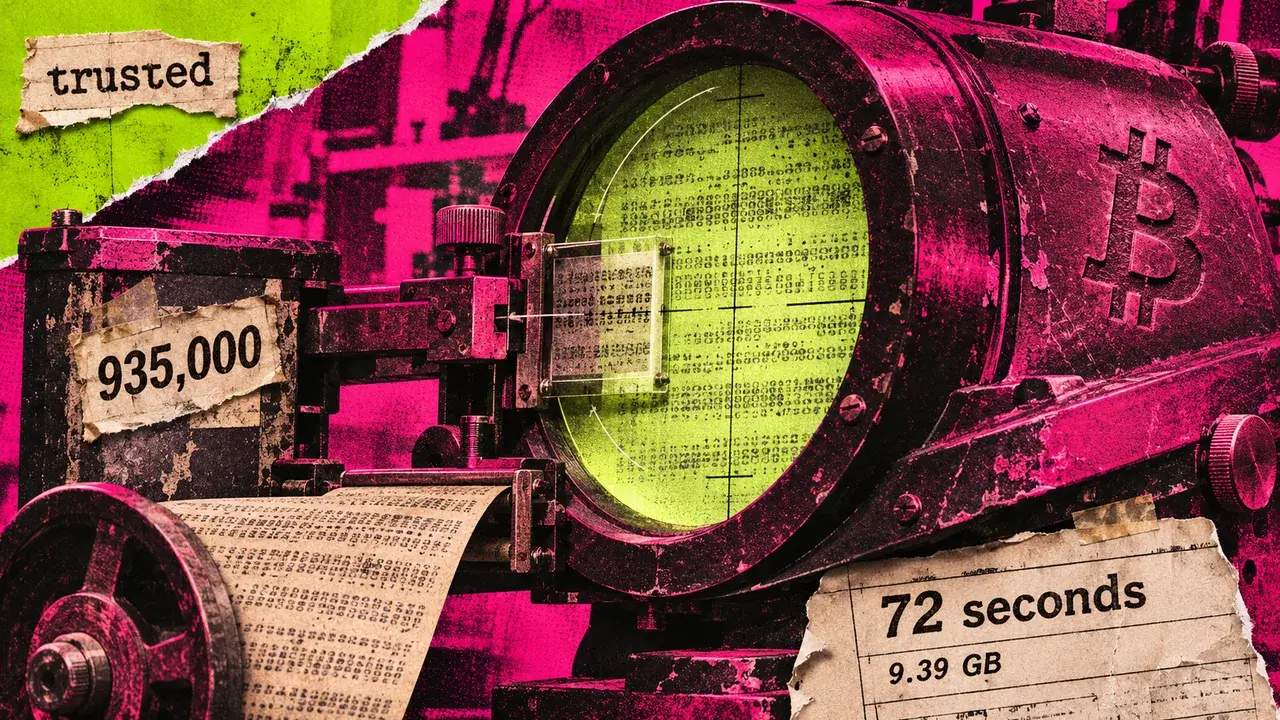
The 72-Second Reality Check
In the world of Bitcoin development, speed is usually a secondary concern to security. We are used to things moving slowly. But a recent demonstration by a Bitcoin developer has the community looking at validation speeds in a different light. The feat involved verifying 164 million unspent coins—the entire Unspent Transaction Output (UTXO) set—in roughly 72 seconds.
For builders, this isn't just a vanity metric. It represents a significant shift in how we think about node performance and the accessibility of the network. If you can verify nearly 10 gigabytes of critical financial data in the time it takes to brew a cup of coffee, the barrier to entry for running a secure, independent node starts to drop significantly.
Understanding the UTXO Set
Before getting into the technical weeds, we need to clarify what was actually being verified. Bitcoin doesn't use accounts like your bank or Ethereum. It uses UTXOs. Think of them as individual gold coins sitting in various vaults. To know the total supply of Bitcoin and who owns what, you have to count every single one of those unspent coins.
The file in question was about 9.39 GB. That is the current weight of all the "change" and "primary" coins sitting in the Bitcoin ledger that haven't been spent yet. Verifying this set is the ultimate proof of the network's integrity. If you can't verify the UTXO set, you are just trusting someone else's word for what the ledger looks like.
The Methodology and the Catch
The developer achieved this speed by focusing purely on the state of the coins rather than the full historical script verification. This is an important distinction for founders to understand. This wasn't a full node sync from genesis—it was a focused check on the current state of the ledger.
By omitting scripts and signatures from this specific check, the process becomes a massive exercise in data hashing and integrity validation. It is a snapshot verification. While this is incredibly useful for quickly auditing the current supply and distribution, it is not a replacement for the full cryptographic history that Bitcoin purists demand for a fresh node setup.
Furthermore, this was an internal demonstration. External reviews are still pending. In crypto, we have a saying: don't trust, verify. Until third-party developers audit the scripts used for this 72-second sprint, we should treat it as a high-potential prototype rather than a new industry standard.
Why Builders Should Care
If you are building an exchange, a wallet, or a layer-2 solution, your biggest bottleneck is often data availability and verification speed. Waiting hours or days for a node to catch up is a friction point that kills user experience.
This demonstration suggests that we are getting much better at optimizing how we handle Bitcoin's core data. It means that future infrastructure might be able to offer "near-instant" state verification without sacrificing the decentralized nature of the network. We are moving toward a world where you don't need a server farm to prove the state of the world's most valuable blockchain.
The Skeptical Take
As much as I love seeing speed records broken, we have to look at the trade-offs. The 9.39 GB file check is separate from browser-based proof verification. There is a risk that by focusing on speed, we start to encourage "pruned" or "lite" versions of verification that miss the forest for the trees.
If we rely too heavily on these snapshots, we might lose the ability to detect deep-history anomalies. As a founder, you have to decide where your product sits on the spectrum of speed versus absolute truth. For most consumer apps, 72-second verification is a dream. For institutional custody? It's just one piece of a much larger security puzzle.
Efficiency vs. Complexity
One of the quiet victories here is the file size. Keeping the entire unspent history of a $1 trillion asset class under 10 GB is a masterclass in efficiency. Compare that to other smart contract platforms where the state size is ballooning into the terabytes, making it impossible for a regular person to run a node.
Bitcoin's simplicity is its greatest feature. The fact that a developer can iterate on these verification scripts and see such drastic performance gains proves that the protocol isn't "stagnant." It is being refined at the edges, making it more resilient and easier to build on.
What Happens Next?
We are waiting on the peer review of these scripts. The real test will be when this methodology is integrated into standard node software or used by auditors to provide real-time proof of reserves. If this becomes a standardized way to audit the chain, it could change how regulatory bodies view Bitcoin's transparency.
For now, builders should keep an eye on the repository. If you can integrate faster state-checks into your backend, you can reduce latency for your users and lower your compute costs. In a bear or a bull market, efficiency is the only thing that actually pays for itself.
The Bottom Line
Scaling doesn't always happen on Layer 2. Sometimes, it happens by making Layer 1 easier to talk to. Verifying 164 million records in 72 seconds is a win for the "small hardware" crowd. It keeps Bitcoin accessible to the hobbyist and the startup founder, not just the data center owner. That is the kind of progress that actually matters for the long-term health of the ecosystem.
Read the original at CryptoSlate →