We have reached that specific point in the market cycle where the chart watchers start dusting off their favorite ominous-sounding terminology. The latest headline making the rounds is the impending Bitcoin death cross. If you aren't familiar with the technical jargon, it sounds like the end of the world. In reality, it is a lagging indicator that tells us what we already know: momentum has stalled.
Understanding the Lag
A death cross occurs when a short-term moving average, typically the 50-day, crosses below a long-term moving average, usually the 200-day. It is intended to signal a transition from a bull market to a bear market. But here is the problem for anyone actually trying to build products in this space: by the time the cross happens, the price has usually already taken its biggest hit.
Technical analysis like this is often a rearview mirror. If you are waiting for the lines to cross to tell you that the market is struggling, you have already missed the exit. For founders and developers, the death cross is less of a prediction and more of a confirmation of the current environment. We are in a period of sideways or downward pressure where capital becomes more expensive and user attention drifts away from the charts.
Thirteen Times Before
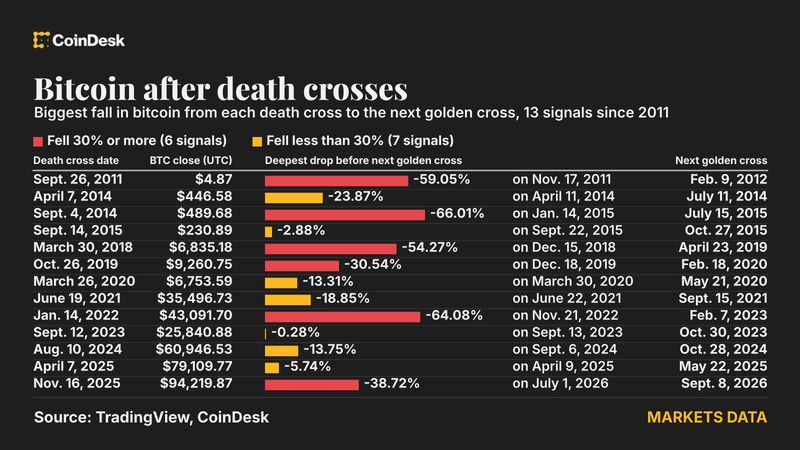
This will be the 14th time Bitcoin has encountered this specific pattern. If you look back at the previous 13 instances, the outcomes are far from consistent. In some cases, it signaled another 20-30% drop. In others, it was actually a contrarian buy signal, marking the absolute bottom of a correction before a massive rally.
Context matters more than the cross itself. In 2026, the macro environment is significantly different than it was in 2014 or even 2020. We have institutional pipelines, ETFs, and sovereign interest that provide a different kind of floor. However, the psychological impact of these technical milestones still drives liquidations. When the retail crowd sees "Death Cross" trending, they panic-sell, which often creates the very liquidity that larger players use to accumulate.
The Founder Perspective
As a builder, your job is to filter out this noise. If your roadmap changes because of a moving average crossover, your strategy was likely too dependent on market euphoria to begin with. The reality is that these periods of technical weakness are actually the most productive times to ship. Why? Because the noise floor drops.
- Talent becomes accessible: When the hype dies down, people stop chasing 100x moonshots and start looking for real projects with actual utility.
- Infrastructure focus: Bull markets are for scaling; bear markets are for fixing the plumbing. If the death cross leads to a stagnant six months, that is six months to refine your UI and harden your security.
- User feedback: The users who stay during a death cross are your core advocates. They aren't here for a quick flip. Listen to them.
Volatility as a Feature
Bitcoin’s price history is essentially a series of aggressive rallies followed by painful corrections. This 14th death cross is just another chapter in that book. The skeptics will use it to claim that Bitcoin is dead—again—ignoring the fact that the network continues to produce blocks every ten minutes regardless of where the 50-day average sits.
We have to stop treating these technical indicators as prophecies. They are observations of past behavior. If the market is trending down, it means liquidity is thinning out. For a startup, that means you need to be more disciplined with your burn rate. It means your value proposition needs to be clearer. You can't rely on a rising tide to lift your boat if the tide is currently going out.
What Happens Next?
Historically, the months following a death cross are characterized by choppy price action. We should expect more of the same. This isn't a time for aggressive leverage or betting the treasury on a quick recovery. It is a time for defensive positioning and focused development.
The market can stay irrational longer than you can stay solvent, but a solid product can outlast any technical indicator.
If you look at the data from the previous 13 crosses, the average recovery time varies wildly. Some saw a return to previous highs within 60 days, while others took nearly a year. This uncertainty is exactly why you don't build a business model around the price of the underlying asset. You build on the technology, not the ticker symbol.
The Takeaway
Do not let the scary terminology distract you from the fundamentals. A death cross is a mathematical outcome of recent price drops, not a supernatural event. Use this period of dampened expectations to solidify your position. While the speculators are arguing over chart patterns, the founders who win will be the ones who kept their heads down and kept shipping. The 14th cross is just another day at the office.
Read the original at CoinDesk →