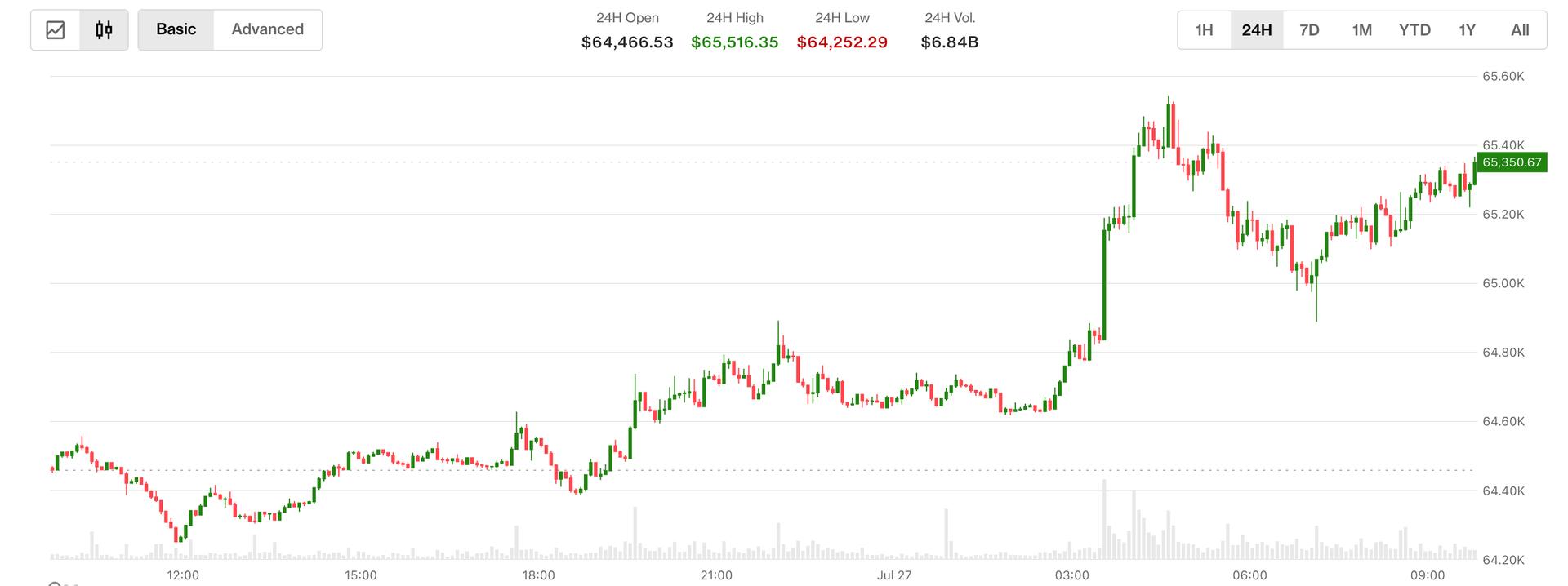
Geopolitics and hair-trigger market reactions have a way of keeping builders on their toes. Over the last 24 hours, we saw a significant relief rally across the board. Bitcoin managed to claw its way back above the $65,000 mark, primarily driven by a visible cooling of tensions between the U.S. and Iran. When the missiles stay in the silos, the charts stay green.
For those of us actually building products rather than just trading candles, this macro environment is exhausting. One day we are looking at total market contagion due to energy price spikes, and the next, oil is dropping 5% because diplomats decided to talk instead of posturing. Brent crude falling off a cliff is usually the signal the market needs to stop hoarding cash and start taking risk again.
The Ethereum Divergence
Wait, there is a more interesting story hidden under the Bitcoin headline. While BTC is doing its usual dance at the top of the food chain, Ethereum has been quietly outperforming it. When ETH starts moving faster than BTC on the upside, it usually means the market is looking for more than just a store of value. It means users and liquidity are starting to flow back toward decentralized applications, Layer 2s, and the broader smart contract ecosystem.
As a founder, I keep a closer eye on the ETH/BTC ratio than the flat dollar price of Bitcoin. Why? Because Bitcoin is a macro hedge, but Ethereum is an ecosystem benchmark. If Ethereum is outrunning Bitcoin, it suggests that the appetite for utility is returning. If you are building on-chain tools, this is the first real signal of life we have seen in weeks.
Energy Costs and the Infrastructure Bottom
The 5% drop in oil prices shouldn't be ignored by the hardware side of the crypto industry. Mining operations and AI data centers have become inextricably linked to the global energy market. When oil drops, it generally lowers the floor for operational costs across the board. This isn't just about gas prices at the pump; it is about the cost of maintaining the massive server farms that power our AI models and secure our blockchains.
We are seeing a convergence where cheap energy allows for higher computational throughput. If these lower energy prices hold, even for a few weeks, it gives infrastructure startups a much-needed margin cushion. Profitability in the mining sector has been razor-thin lately, and this dip in oil gives those operators a chance to breathe, upgrade equipment, and prepare for the next wave of demand.
Why Builders Should Stay Skeptical
I know the temptation is to see a $65,000 Bitcoin and think the bull run is back in full force. I would caution against that. This jump is reactionary. It is a relief rally based on the absence of bad news, not necessarily the presence of good structural news. We are still dealing with high interest rates and a global economy that feels like it's held together by duct tape and high-yield debt.
If your project relies on prices staying at this level just to survive, you are in a risky spot. The best way to use this current pump is to shore up your treasury and keep your head down. Volatility based on geopolitical events is the most fickle kind of growth. What one diplomat says tomorrow could erase these gains by lunchtime.
The Shift Toward Utility
The fact that ETH is leading this charge is the primary takeaway for anyone in the AI or crypto space. For a long time, the narrative was dominated by "digital gold." That is fine for institutional portfolios, but it does not help us build better software. When ETH gains momentum, it brings attention back to gas fees, throughput, and the actual usage of the networks.
We are seeing more developers move toward hybrid AI-on-chain models. The influx of liquidity into Ethereum means there is more capital available for these experimental integrations. If you are working on decentralized compute or AI-driven smart contracts, this is your time to push for visibility. The market is finally looking for something to do with its capital other than just letting it sit in a ledger.
The market can stay irrational longer than you can stay solvent, but a market based on relief is just a breather before the next test of utility.
Strategic Takeaways for Foundations
- Focus on Ecosystem Growth: With ETH leading, look at your integrations. Are you making it easy for users to bridge and interact with your DApp while the fees are manageable?
- Optimize for Energy: If you are running heavy compute, use this window of lower energy pressure to optimize your infrastructure.
- Ignore the Noise: $65,000 is just a number. It doesn't change the code you wrote this morning. Don't let a green candle distract you from your roadmap.
- Treasury Management: If your startup has a significant portion of its runway in volatile assets, use these spikes to de-risk.
The reality is that we are in a holding pattern. The U.S. and Iran holding fire is good news for humanity, but in the markets, it's just a temporary reprieve. As builders, we should be thankful for the stability, but we shouldn't trust it. The long-term winners are the ones who can survive the $50,000 dips, not just the ones who celebrate the $65,000 peaks.
Watch the altcoin space closely over the next few days. If Ethereum continues to climb against Bitcoin, we could see a broader rotation into utility-based tokens. This is where the real opportunities for founders lie—not in the macro politics of oil, but in the micro economics of user adoption.
Read the original at CoinDesk →