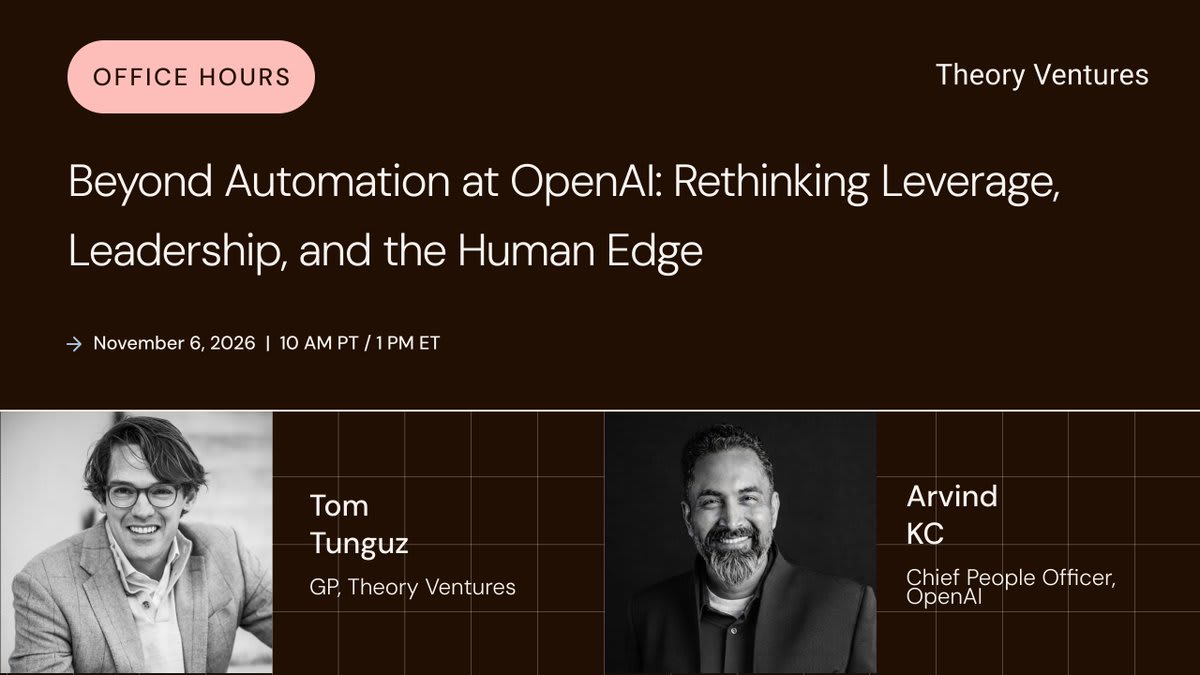
We have spent the last decade obsessed with efficiency. In the SaaS era, success was measured by how many humans you could replace with a script or a dashboard. But if you talk to the people actually building the frontier, like OpenAI’s Chief People Officer Arvind KC, you realize we are moving past the era of simple automation. We are entering the era of amplification.
Arvind recently sat down to discuss the shift in how organizations function when model capabilities are doubling every six months. The takeaway for founders isn’t that your team will get smaller; it’s that the nature of what a “team” is has fundamentally broken. If you are still hiring based on a 2021 playbook, you are building a legacy company in a real-time world.
The Fall of Efficiency
In most corporate circles, AI is discussed as a way to cut costs. You use a chatbot to deflect support tickets or a generator to churn out social media posts. This is a low-level view of the technology. When the core intelligence of your tools is compounding at a rate that outpaces human learning, chasing 10% efficiency gains is a waste of time.
The goal now isn’t to do the same things with fewer people. It is to do things that were previously impossible. For builders, this means shifting focus from “how do I automate this task” to “how do I democratize this capability.” At OpenAI, the internal people team isn’t just trying to process payroll faster; they are looking at how to amplify the most valuable capabilities of their engineers and researchers.
Efficiency is a defensive metric. Amplification is an offensive one. In a world where intelligence is becoming a commodity, the winners won’t be the ones who saved the most on overhead. They will be the ones who leveraged that cheap intelligence to build products that 1,000-person teams used to struggle with.
The New Span of Control
Management theory usually suggests a “span of control” of about seven to ten people. Any more and you lose the thread; any fewer and you’re micromanaging. Arvind suggests this metric is about to explode. We are moving toward a reality where a single human leader might direct hundreds, even thousands, of agents.
Think about what that does to the role of a founder. You are no longer a manager of personalities and calendars; you are an orchestrator of intent. This requires a level of clarity that most builders lack. If you give a vague instruction to a human, they can ask for clarification or use their intuition to fill the gaps. If you give a vague instruction to a fleet of a thousand agents, you just generate a thousand units of high-speed garbage.
The skill set shifts from “management” to “architecture.” You are designing systems of work where agents handle the execution and humans handle the strategy and the edge cases. This isn’t just a change in tools; it’s a change in the definition of a career. The “manager” of the future looks more like a technical director than a traditional boss.
The EQ Moat
Here is the irony of the AI boom: as intelligence becomes cheaper and more accessible, the value of non-scalable human traits goes up. When anyone can generate a perfect piece of code or a beautiful legal brief for pennies, those things stop being competitive advantages.
Arvind points out that emotional intelligence (EQ) becomes the leader’s primary edge. In an environment where the technical work is being handled by agents, the human leader’s job is to provide the “why.” You have to manage the psychological state of your human team, maintain the mission, and navigate the complex ethics of what you are building.
“When intelligence is cheap, emotional intelligence becomes the premium.”
I see founders struggling with this. They think they can “prompt” their way out of culture problems. You can’t. In fact, the faster your company moves because of AI, the more likely it is to fly off the rails if the culture isn’t solid. You need humans who can trust each other, because you won’t have the time to double-check every output of an autonomous system. Trust is the lubricant for high-velocity AI organizations.
What This Means for Builders
If you are building a startup today, you need to stop hiring for “skills” that are easily replicated by a context-window-capable LLM. If a job description is just a list of repetitive tasks, that job shouldn’t exist. You should be hiring for people who can direct agents and who possess the high-level judgment to know when the agents are hallucinating or steering the ship into a wall.
- Focus on Intent: Train your team to be precise in their objectives. The quality of your company is now equal to the clarity of your instructions.
- Redefine Output: Stop measuring hours worked. Measure the leverage each person creates. A “junior” employee with high AI literacy can now out-produce a senior executive from the old guard.
- Invest in the “Human” Layer: Don’t let your culture become a series of Slack pings and automated updates. As the work becomes more automated, your physical and social connection points need to be more intentional.
The transition from Palantir to OpenAI gives Arvind a unique perspective on the “people” function. At Palantir, it was about finding the signal in the noise of data. At OpenAI, it’s about managing the explosion of capability. The common thread is that humans are still the ones who decide what is worth doing.
We are moving away from a world where we work for the machines, and toward a world where we are the conductors of an immense digital orchestra. It’s a more powerful position, but it’s also more demanding. You can’t hide behind “being busy” anymore. When the execution is free, the only thing that matters is the quality of your ideas and your ability to lead the people behind them.
The Takeaway
Don’t build a company that uses AI to be 20% more efficient. Build a company that uses AI to be 100x more capable. Hire for judgment and EQ, because those are the only two things that won’t be commoditized by the next model update.
Read the original at Tomasz Tunguz →