The Scale of the System
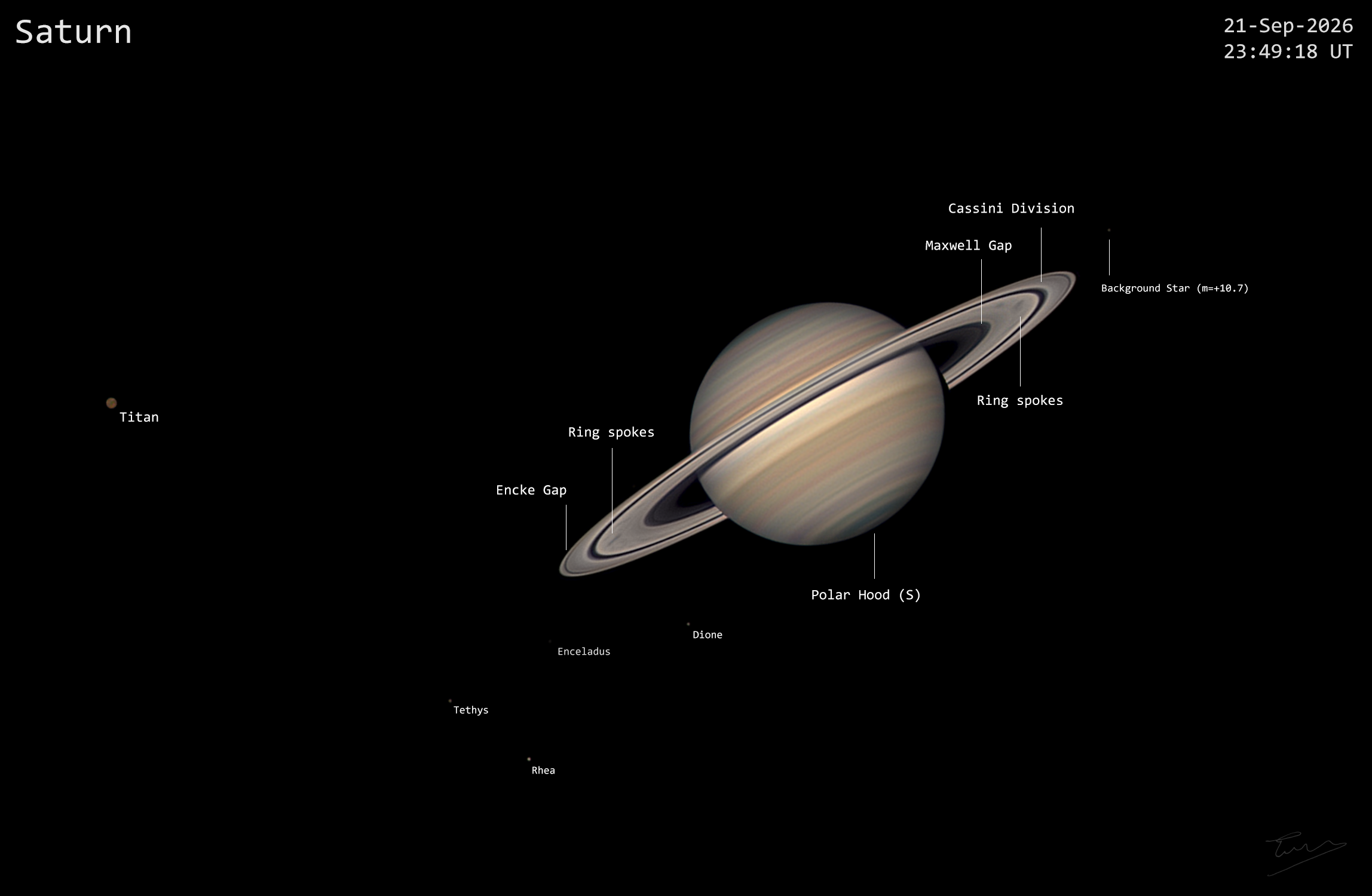
When you look at the recent data coming back from the Saturn system, it is easy to get lost in the aesthetics. Astronomers call it a smörgåsbord for a reason. You have the rings, the dozens of moons, and the massive gravity well of the gas giant itself. But for those of us building in the tech and crypto space, there is a much deeper lesson here about architecture and resilience.
We often talk about building "ecosystems" in Web3. Usually, that is just marketing speak for a Discord server and a token. But Saturn is a real ecosystem. It is a masterclass in how multiple distinct entities—moons like Titan and Enceladus—can exist within a single gravitational influence while maintaining completely different internal compositions and functions. It is the ultimate multichain environment, operating without a central coordinator for billions of years.
Gravity as Protocol
In the Saturn system, gravity is the protocol. It is the hard-coded rule set that determines where every particle of ice and every massive moon can exist. There is no central authority adjusting the orbits. If an object doesn't follow the physics of the system, it either crashes or gets ejected. This is exactly how we should be thinking about smart contracts and decentralized autonomous organizations. The rules should be the physics of the platform, not something a founder can tweak because they had a bad quarter.
Looking at the complexity of the rings, we see millions of individual pieces of debris working in concert to create a visible, coherent structure. From a distance, it looks like a solid disk. Up close, it is pure chaos. This is the reality of building a large-scale network. If you try to control every transaction at the micro level, the system breaks. You have to let the protocol—the gravity—handle the alignment while the individual components do their own thing.
The Lesson of Diversity
What makes the Saturnian system so fascinating to a founder is the lack of uniformity. You have Titan, which has its own thick atmosphere and liquid methane lakes, sitting just a few hundred thousand kilometers away from Mimas, which is essentially a dead, cratered ball of ice. They both belong to the same system, but they serve different roles and possess different utilities.
In crypto, we are obsessed with one-size-fits-all solutions. We want every L2 to look the same or every DAO to follow the same governance template. The Saturn smörgåsbord proves that a system is stronger when its components are specialized. We need chains that are built specifically for privacy, others for high-speed throughput, and others for long-term storage, all orbiting a stable, heavy protocol layer.
Infrastructure and Longevity
Building something that lasts is the hardest part of tech. Most startups are lucky to survive five years. The Saturn system has been stable for ages, despite constant bombardment and shifting internal dynamics. This is because the infrastructure is built on fundamental truths. In our world, those truths are cryptography and decentralized consensus.
When I see images of the Saturn system, I don't see a pretty picture; I see a stress test. I see a system that has survived the worst the universe can throw at it because it doesn't rely on a single point of failure. If one moon gets struck by an asteroid, the rings don't disappear. The system adapts. Builders need to stop creating fragile hierarchies and start building systems that can absorb shock.
The Founder's Perspective
If you are a founder today, you are likely feeling the pressure to consolidate, to simplify, and to follow the trend. But the most successful systems in history—natural or otherwise—are those that embrace a variety of functions. The "smörgåsbord" approach isn't about being messy; it's about being comprehensive. It is about understanding that your network needs to provide a wide range of services and environments to survive the long game.
We are currently in the "early exploration" phase of AI and blockchain. We are just now getting our first clear pictures of what is possible. Like the Cassini mission that gave us so much of this data, we have to be willing to send our projects into the unknown, far away from the safety of the status quo, to see what actually works when the gravity gets heavy.
Final Takeaway
Complexity is not the enemy; fragility is. The Saturn system is incredibly complex, yet it is one of the most stable structures in our solar system. For builders, the goal isn't to make things simpler for the sake of simplicity. The goal is to create robust protocols that allow for infinite variety and specialization to flourish on top of them. Build for gravity, not for control.
Read the original at NASA Breaking News →