The Convergence of Rare Data
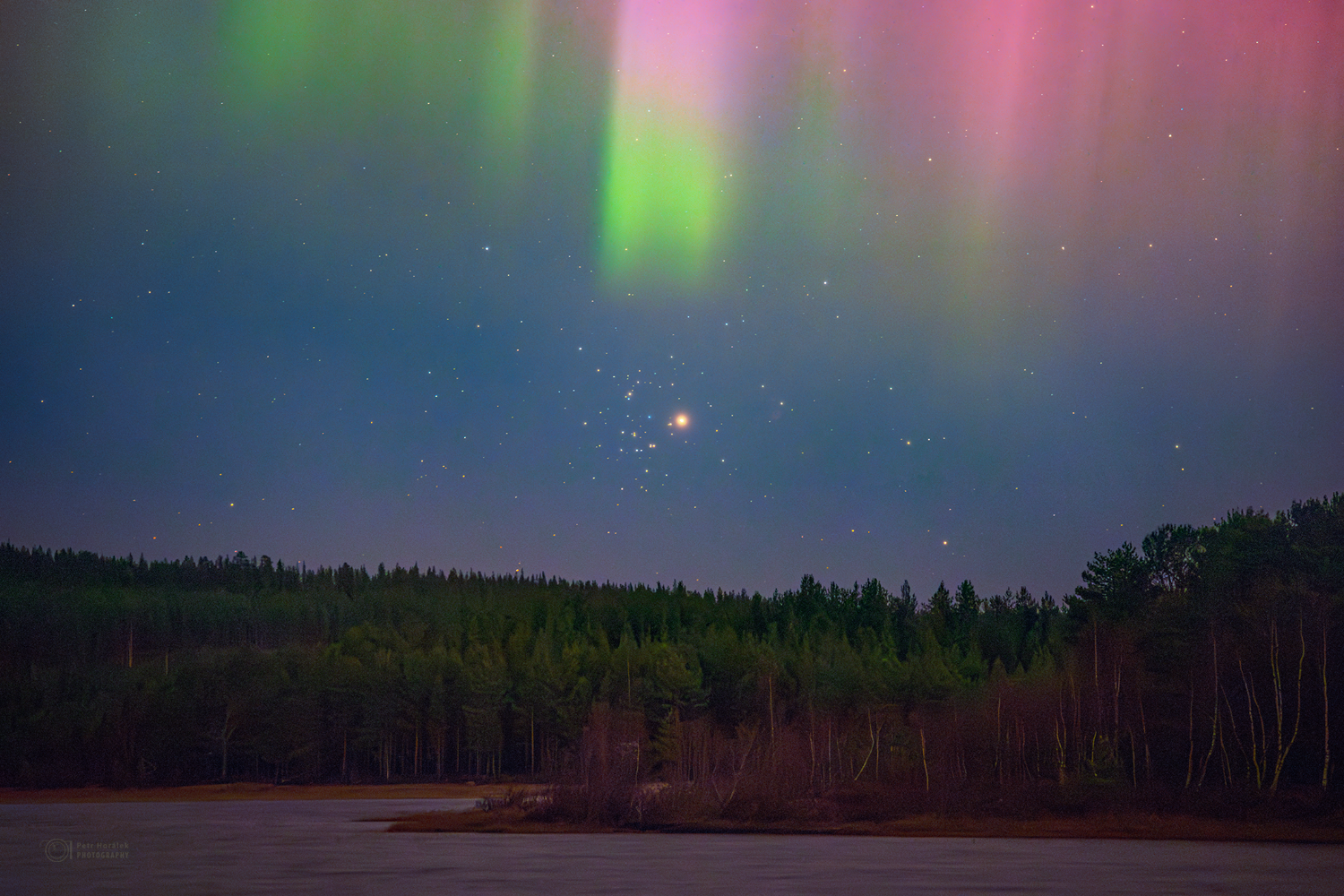
I recently looked at an image captured near Lansjärv, Sweden, that feels like a metaphor for the current state of decentralized infrastructure. It shows Mars, the Beehive star cluster, and a massive aurora curtain all occupying the same vertical slice of the sky. In the space business, we call this a high-value signal. In the builder world, we call it a stress test for our sensors.
For those of us working at the intersection of crypto and physical hardware, this isn't just a pretty picture. It is a reminder of how rare high-fidelity data truly is. When you have three distinct astronomical phenomena happening in one frame, you aren't just looking at luck; you are looking at the necessity of being in the right place at the right time with the right equipment. This is the core problem DePIN projects are trying to solve.
The Geographic Bottleneck
The image shows Mars joining the M44 Beehive cluster under a localized auroral event. Most people see the beauty. I see the distribution problem. NASA and other space agencies rely on a handful of high-end observation points. But as we move toward a world where we need real-time monitoring of atmospheric changes, solar flares, and low-earth orbit traffic, we cannot rely on centralized hubs.
The location in Lansjärv is remote. It represents the "edge" of the network. If we want to build resilient systems for monitoring the planet or the space around it, we need more eyes on the ground in these specific, often inconvenient locations. This is where decentralized physical infrastructure networks come in. By incentivizing individuals to host sensors in places like rural Sweden, we move from capturing one-off "lucky" shots to having a persistent, verifiable stream of global data.
Why Builders Should Care
If you are building in the AI or crypto space right now, you are likely dealing with a data hunger problem. We have plenty of synthetic data, but we are running low on authentic, high-entropy environmental data. An event like this—Mars passing the Beehive during an aurora—is a complex data set. It involves varying light intensities, movement, and electromagnetic interference.
Builders need to stop thinking about data as something you just scrape from a central database. We need to start thinking about the provenance of that data. Who captured it? Was the sensor calibrated? Is the timestamp verifiable on-chain? When we look at a cosmic coincidence like the one in Sweden, the value isn't just in the pixels; it is in the verification that this event actually occurred exactly as recorded.
The Founder Perspective on Hype
There is a lot of noise in the space-tech and AI industries right now. Everyone wants to talk about colonizing Mars or building AGI that can predict the weather with 100% accuracy. But we are still struggling with basic visibility. We are still relying on a few photographers and scientists to be in the right spot at the right time.
From a founder’s perspective, the opportunity isn't in the aurora itself. The opportunity is in the gap between what happened and what was recorded. If you can build a protocol that makes capturing these rare occurrences permissionless and profitable for the provider, you aren't just making a gallery; you are building a new layer of the internet. We need to get away from the "happy little trees" mentality and move toward a robust, industrial-grade data economy.
The Skeptic’s Corner
I am skeptical of any project that claims they can automate this kind of observation without a massive, distributed human element. The Swedish image was possible because a human made a choice to be there. AI can process the image, but it cannot yet decide to build the infrastructure in a remote Swedish village based on a hunch about solar activity. We are still a long way from fully autonomous environmental monitoring.
We also have to talk about the hardware. High-end astronomical photography requires gear that costs thousands. If we want to decentralize this, we need to bring down the cost of entry for the average person to participate in these networks. A sensor that can only see one thing is a toy. A sensor that can see Mars, a star cluster, and an aurora simultaneously is a tool. We need more tools.
The Long Game
What this specific alignment teaches us is that the universe is chaotic but patterned. Mars will always move along its path, and the Beehive cluster isn't going anywhere. The variable is the aurora—the solar wind hitting our atmosphere. That is the unpredictable element.
In business, we deal with these same dynamics. We have the fixed costs and the steady markets (the stars), and then we have the sudden, volatile shifts in technology and regulation (the aurora). The companies that survive are the ones that are positioned to capture the value of the volatility without losing sight of the fundamentals.
Real-time observation is the ultimate commodity in an era of deepfakes and synthetic noise.
We are entering a phase where "seeing is believing" is no longer enough. We need to be able to prove that what we are seeing is an objective reality. A photo from NASA is a start, but a thousand verified data points from a decentralized network is the future. If you are building in this space, focus on the verification layer. The pretty pictures are just the marketing.
The Takeaway
The alignment over Sweden is a reminder that the most valuable data often happens at the edges of our network. Whether you are building a DePIN project, an AI model, or a new observation tool, the goal is the same: reduce the reliance on luck and increase the surface area of our awareness. Stop waiting for the perfect shot and start building the network that ensures you never miss it.
Read the original at NASA Breaking News →