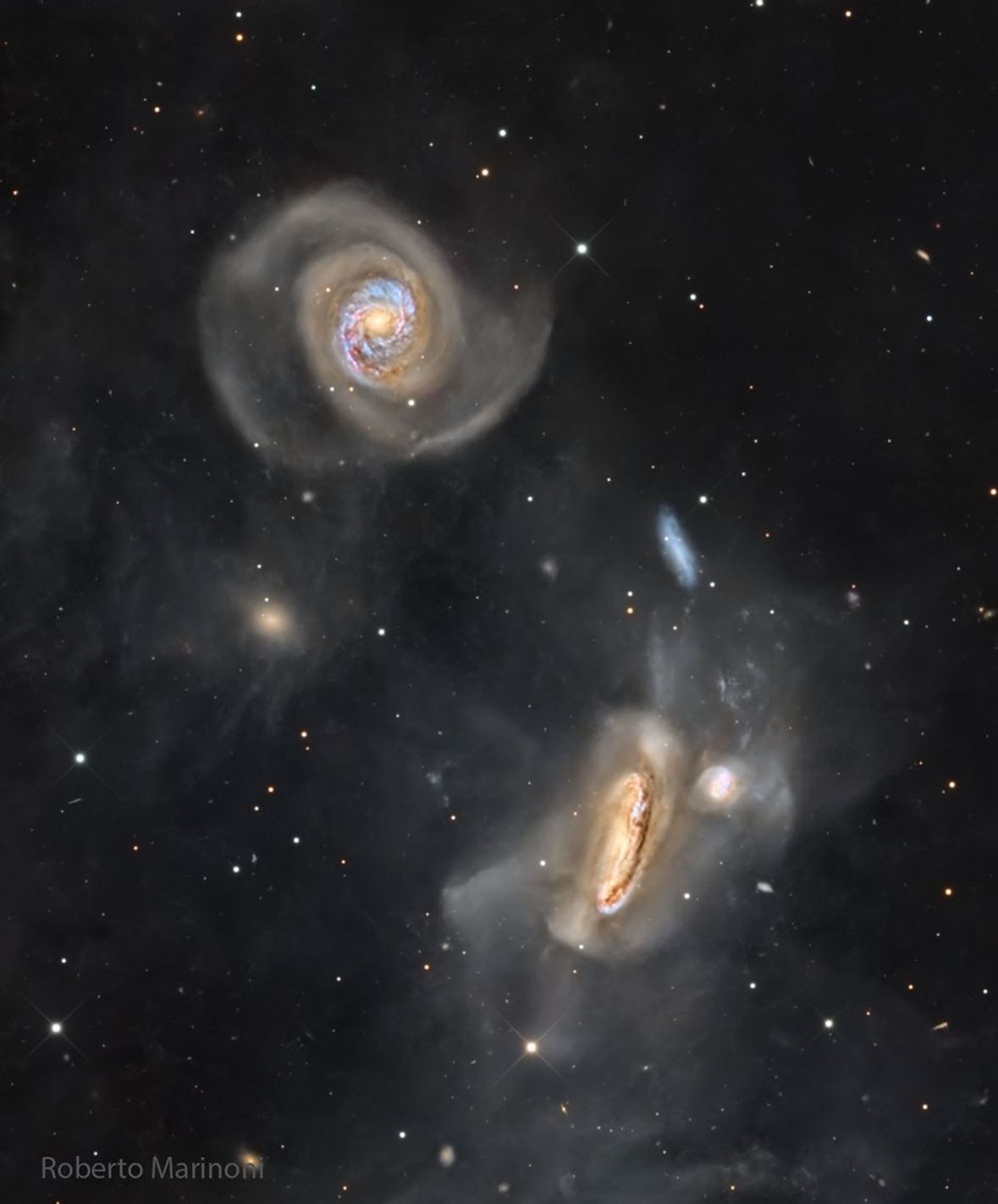
When we look at NASA’s recent imagery of the NGC 7771 group, most people see a beautiful, chaotic dance of light. They see high-resolution celestial photography. But for those of us building in volatile markets like crypto and AI, these images look a lot more like a boardroom battle or a hostile takeover. What we are witnessing is a slow-motion collision of giants, and it provides a perfect metaphor for the consolidation cycles we see in tech.
The Mechanics of Merging
In the NGC 7771 group, several galaxies are being pulled together by gravity. Over millions of years, these individual entities will lose their unique shapes, their orbits will degrade, and eventually, they will merge into one massive post-merger entity. This isn't a clean process. It involves massive tidal forces, star formation triggered by friction, and a lot of cosmic debris being thrown into the void.
For a founder, this is the reality of the "merger and acquisition" landscape. We often talk about decentralization as this permanent state of being, but nature tends to prefer clumps. In the early days of a tech cycle, we see thousands of individual "stars" or startups. But eventually, the gravity of capital and user bases starts pulling them together. If you aren't big enough to have your own gravitational pull, you end up becoming a satellite to someone else, or worse, you get shredded by their tidal forces.
Why Gravity Matters in Building
In physics, gravity is a function of mass. In the startup world, mass is your network effect and your moat. If you are building a tool that relies on a single API from a larger player, you are effectively a small satellite galaxy orbiting a massive one. You might think you are independent, but your trajectory is entirely dictated by the larger body's movement.
- Total Addressable Market: This is the space you occupy. If the space is too crowded, collisions are inevitable.
- Resource Velocity: Just as gas clouds in these galaxies ignite into new stars during a collision, market competition can force innovation. However, that innovation often consumes the very resources that were supposed to sustain the long-term mission.
- The Big Crunch: Eventually, the distinct features of the original entities disappear. This is the corporate equivalent of a brand being swallowed by a parent company and turned into a feature set.
Lessons from the NGC 7771 Conflict
The imagery from NASA shows these galaxies in a state of "battle." This isn't a choice; it's a consequence of their proximity. In the AI space right now, we are seeing this exact phenomenon. Every small LLM wrapper and niche tool is being pulled into the orbit of the giants like OpenAI or Google. They aren't just competing; they are literally being absorbed or destroyed by the sheer mass of the larger players.
Builders need to recognize when they are in a collision course. If you are in the NGC 7771 group, you don't just stay a spiral galaxy forever. You either become the center of the new formation or you become the background noise. This is why I always tell founders to look at their competition not just as rivals to beat, but as gravitational bodies. Are you being pulled toward them? Is your talent leaving for their higher mass? Is your user base drifting into their orbit?
Success in a consolidated market isn't about avoiding the collision; it is about surviving the merger with your core mission intact.
The Entropy of Decentralization
We love the idea of a decentralized web where millions of small nodes exist independently. But if we look at the universe, entropy and gravity always win. Things tend to clump. We saw it with the early internet (thousands of ISPs merging into three or four), and we are seeing it with Layer 2 solutions in the crypto space. There are too many chains, too many protocols, and not enough users to sustain them all. The "galactic battle" for liquidity is already underway.
When these protocols collide, it isn't always a bad thing. In the NASA image, the friction creates new stars. In tech, these collisions create new industries. The debris from a failed startup often provides the "stardust" for the next big breakthrough. But if you are the one holding the equity in the galaxy being shredded, it feels less like a miracle of the cosmos and more like a disaster.
The Founder Perspective: Navigating the Void
So, how do you avoid being the galaxy that gets torn apart? You have to build mass early. In the NGC 7771 group, the dominant galaxy remains the anchor. It survives the merger because its core is dense enough to withstand the tidal forces. For a builder, that density is your technology and your community.
If your community is just a bunch of speculators, you have no density. You are a loose gas cloud that will be blown away the second a larger player moves into your territory. If you have a core of builders and users who are deeply integrated into your ecosystem, you have a solid nucleus. You might still merge, but you will do so as the surviving partner, not the discarded shell.
Final Reality Check
We spend a lot of time looking at the stars and dreaming about the future of tech. But the laws of physics are indifferent to our roadmaps. Consolidation is a natural force. Whether it's galaxies or GPU clusters, the big get bigger and the small get assimilated. If you want to survive the next decade of AI and crypto, you need to stop thinking about your project in isolation and start looking at the gravitational map of your industry.
The battle in NGC 7771 is beautiful because it’s happening millions of light-years away and takes millions of years to resolve. In tech, the same battle happens in eighteen-month cycles. Don't get caught in the tidal tail.
Read the original at NASA Breaking News →