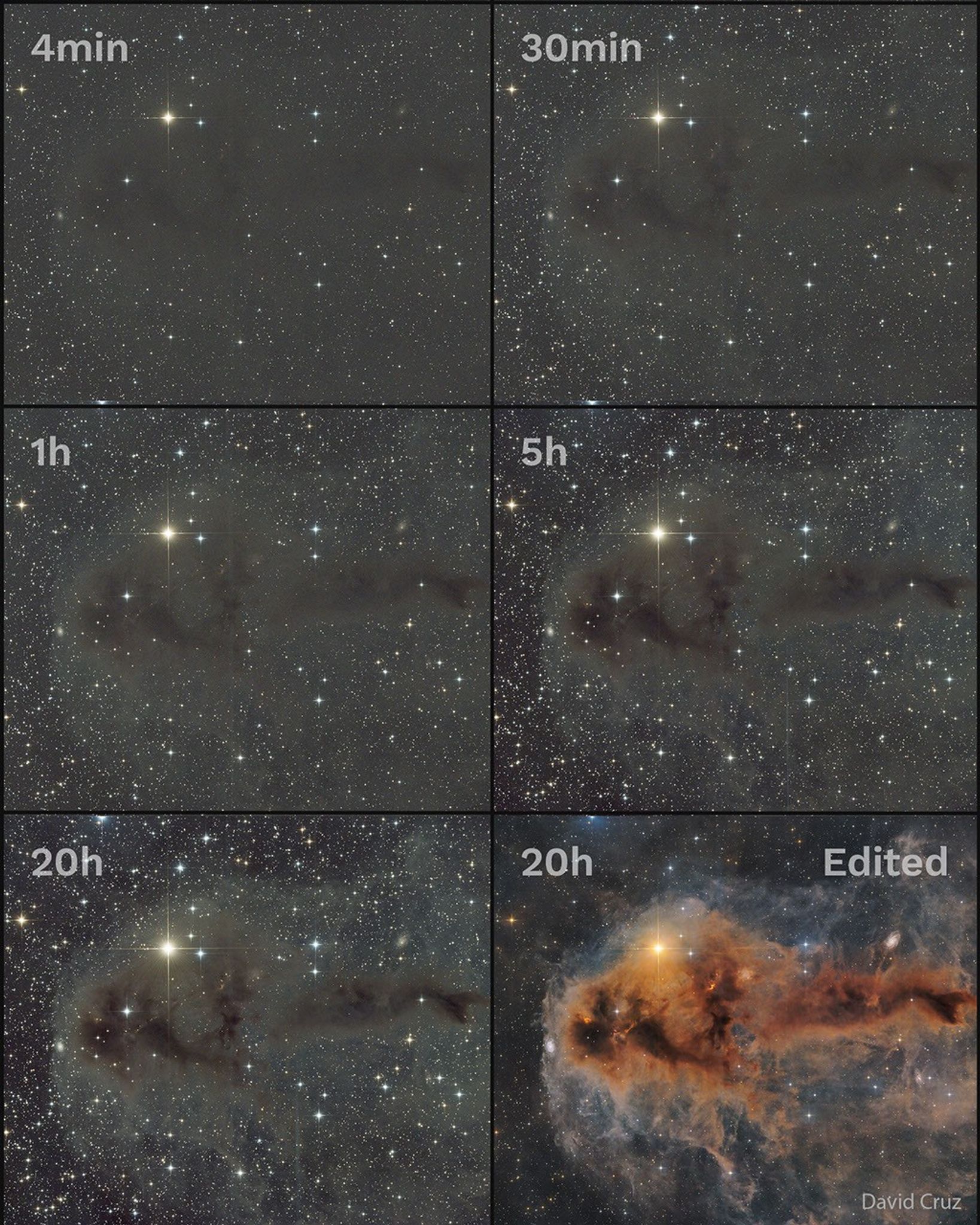
We spend a lot of time talking about the visible layers of technology. The flashy front-ends, the viral AI agents, and the tokens that pump on X. But builders know that the most interesting stuff usually happens in the dark spaces where nobody is looking. This week, NASA dropped a high-definition look at Lynds 1251, a dark nebula sitting roughly 1,000 light-years away. For the average observer, it looks like a dusty void. For a founder, it looks like an early-stage ecosystem.
The Invisible Infrastructure
Lynds 1251 isn't just a cloud of dust. It is a molecular factory. Known as a dark nebula, it is so dense with interstellar dust that it obscures the light from stars sitting behind it. In astronomy, these are often called 'dark clouds.' In crypto and AI, we call this the infrastructure phase. It is the period where projects are absorbing resources, talent, and capital, but haven't yet emitted enough 'light' or utility for the public to understand what is being built.
The imagery provided by telescopes today allows us to see into these clouds using infrared, revealing that these dark patches are actually the birthplaces of stars. Inside Lynds 1251, gravity is slowly pulling together pockets of gas and dust. Once the pressure hits a certain threshold, a star is born. This mirrors the lifecycle of a high-conviction startup. You spend years in the dark, accumulating data and refining code. You look like a void to the outside world until the moment of ignition.
Why Founders Should Care About the Void
There is a lesson here about noise versus signal. Most people look at the sky and focus on the brightest stars. Those are the 'legacy' projects. They are burning bright, but they are also burning out. The dark nebula represents the future. If you want to know where the next decade of innovation is coming from, you don't look at what is already glowing; you look at where the dust is most dense.
- Density matters: Just as Lynds 1251 needs massive amounts of gas to create a star, AI models need massive amounts of compute and clean data.
- Obscurity is a feature: Being hidden allows for development without the distraction of market volatility.
- Gravity is the team: The core force holding a nebula together is gravity. In a bear market or a quiet building phase, the only thing keeping a project from dissipating is the gravitational pull of a strong founding team.
NASA's look at this nebula shows us that the universe isn't just a collection of finished products. It is a work in progress. When we see objects like Lynds 1251, we are looking at the 'testnet' of the cosmos.
The Mechanics of Formation
When you look closely at the edges of Lynds 1251, you see these glowing ridges. That is where high-energy radiation from nearby stars is eroding the cloud. It’s a constant battle between the internal pressure of the nebula and the external forces of the galaxy. This is essentially the regulatory and competitive environment for any new tech stack. You are trying to build something cohesive while the 'radiation' of the market tries to pull you apart.
Building in a 'dark nebula' state requires a different kind of stamina. You aren't getting the dopamine hits of public validation. You are relying on the physics of your build. For those working on decentralized physical infrastructure (DePIN) or niche LLMs, the Lynds 1251 phase is where you spend 90% of your time. If you can't handle the dark, you’ll never make it to the ignition point.
"The most productive systems often look like nothing is happening until everything happens at once."
The Shift to Infrared Thinking
To see what’s inside Lynds 1251, astronomers can't use standard optical tools. They have to shift to infrared. They have to look for heat signatures. As a builder or an investor, you have to do the same. You can’t judge a project based on its 'optical' visibility (social media following, PR stunts). You have to look for the 'heat'—the developer activity, the GitHub commits, the actual movement of data.
We are currently entering a period where the hype in AI is cooling off slightly, moving into a more 'nebula-like' state. The flashy demos are being replaced by the hard work of fine-tuning and vertical integration. This is a good thing. The 'dark' phases are where the most valuable assets are formed. If the sky was only filled with bright stars, there would be no room for anything new to grow.
Takeaway for the Week
Don't be afraid of the quiet periods. If you are building in a space that currently feels like a void, remember Lynds 1251. The density of your work is what determines the brightness of your eventual output. In the cosmos, as in crypto, the biggest things start in the dark. Stop looking for the light and start focusing on the mass. If you get the mass right, the light will take care of itself.
Read the original at NASA Breaking News →