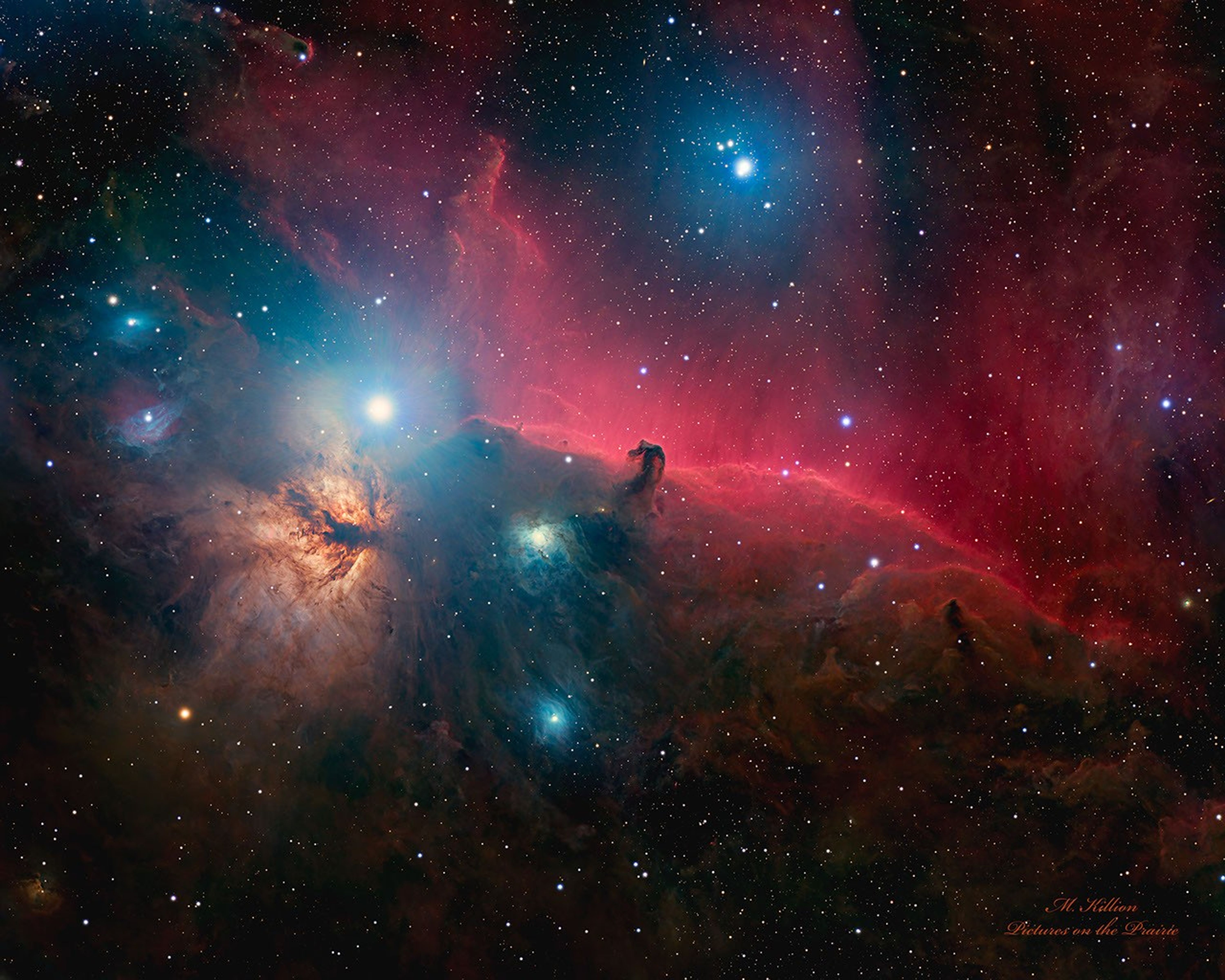
We spend a lot of time looking at screens, but we rarely think about the infrastructure required to capture what is happening millions of light-years away. NASA recently released a high-definition look at the Horsehead and Flame Nebulas, located in the constellation Orion. For most people, it is a desktop wallpaper. For those of us building in tech, it is a reminder of the massive gap between raw data and usable visualization.
The Architecture of Cosmic Data
When you look at the Horsehead Nebula, you are not looking at a single snapshot taken by a standard camera. This is the result of deep-space telemetry, sensor fusion, and post-processing. The Horsehead, or Barnard 33, is a dark molecular cloud. It only becomes visible because it is silhouetted against a backdrop of glowing gas. To capture this, NASA utilizes instruments that operate far beyond the visible spectrum.
For builders, this is a lesson in signal versus noise. The universe is incredibly noisy. To get a clean image of a nebula, astronomers have to filter out foreground stars, cosmic rays, and sensor artifacts. It is the ultimate data-cleaning pipeline. If you are struggling to clean a dataset for a local LLM, imagine trying to calibrate a sensor sitting in a vacuum while being bombarded by solar radiation.
Why Builders Should Care About Imaging Tech
The tech stack behind these images is evolving. We are moving away from simple observation toward predictive modeling of cosmic structures. The Flame Nebula, visible near the star Alnitak, is a complex of gas and dust being ionized by ultraviolet light. Understanding the composition of these areas requires massive computational power.
- Data Transmission: Getting high-resolution files from deep space requires sophisticated compression and error-correction protocols.
- Sensor Fidelity: The transition from CCD to more advanced CMOS-based sensors in space hardware mirrors the shifts we see in consumer edge AI devices.
- Open Source Access: Much of the raw data from these missions eventually hits the public domain, providing a sandbox for developers to build their own visualization tools.
The real opportunity here isn't just in looking at the stars; it is in the software that interprets the light. We are seeing a convergence of computer vision and astrophysics. If you can build a model that identifies structural anomalies in a nebula, you can likely apply those same spatial-recognition principles to autonomous drones or medical imaging.
The Skeptic's View: Beyond the Pretty Pictures
I tend to be skeptical of the "space hype" cycle. We see these images and think we are close to interstellar travel, but the reality is much more grounded. These nebulas are hundreds of light-years away. What we see today is ancient history by the time the light hits the sensor. However, the engineering required to bridge that distance is where the real value lies for founders.
We are currently seeing a surge in private aerospace startups focusing on "Earth observation" and orbital logistics. The same imaging pipelines used for the APOD (Astronomy Picture of the Day) are being repurposed to track supply chains, monitor climate shifts, and provide real-time intelligence for the defense sector. The Horsehead Nebula is the marketing; the underlying telemetry is the business.
Infrastructure is the Real Star
Building for space is the ultimate stress test for any hardware or software stack. There is no "hotfix" when your server is orbiting the sun. This forces a level of discipline in code quality that we rarely see in the "move fast and break things" world of Web3 or consumer apps. When NASA or ESA engineers build, they build for decades, not for the next funding round.
The discipline required to capture a clear image of the Flame Nebula is exactly the kind of technical rigor we need in the AI space today. It is about precision, not just scale.
If you are a founder looking for a moat, look at the problems NASA is solving. They are dealing with extreme latency, low-bandwidth environments, and hardware that cannot be physically touched for years. These are the same problems we face when building decentralized networks or edge computing nodes in remote areas.
Practical Takeaways for the Tech Community
Don't just admire the aesthetics of the Horsehead Nebula. Analyze the process. We are entering an era where space data will become a commodity. Just as we have APIs for weather and financial markets, we will eventually have streamlined APIs for orbital data. The builders who understand how to process this information today will be the ones who lead the space-economy tomorrow.
The Flame Nebula looks like a fire in the sky because of the way hydrogen gas interacts with the light from nearby stars. In the tech world, your product is the gas and your market is the light. Without the right interaction, you are just an invisible cloud of dust. It takes a specific set of conditions to make something visible and valuable.
Final Thoughts on the Orion Complex
The Orion constellation is a frequent target for astronomers because it is a stellar nursery. It is where things are born. For those of us in the startup world, it should serve as a metaphor for the raw potential of the current tech landscape. We have the data, we have the processing power, and we have the sensors. The only thing missing is the clarity of vision to turn that raw input into something meaningful.
We don't need more hype. We don't need more filtered photos that obscure the truth. We need better tools to see the universe—and our own industries—as they actually are. NASA’s latest release isn't just a picture; it’s a benchmark for what is possible when you combine high-level engineering with a clear objective.
Read the original at NASA Breaking News →