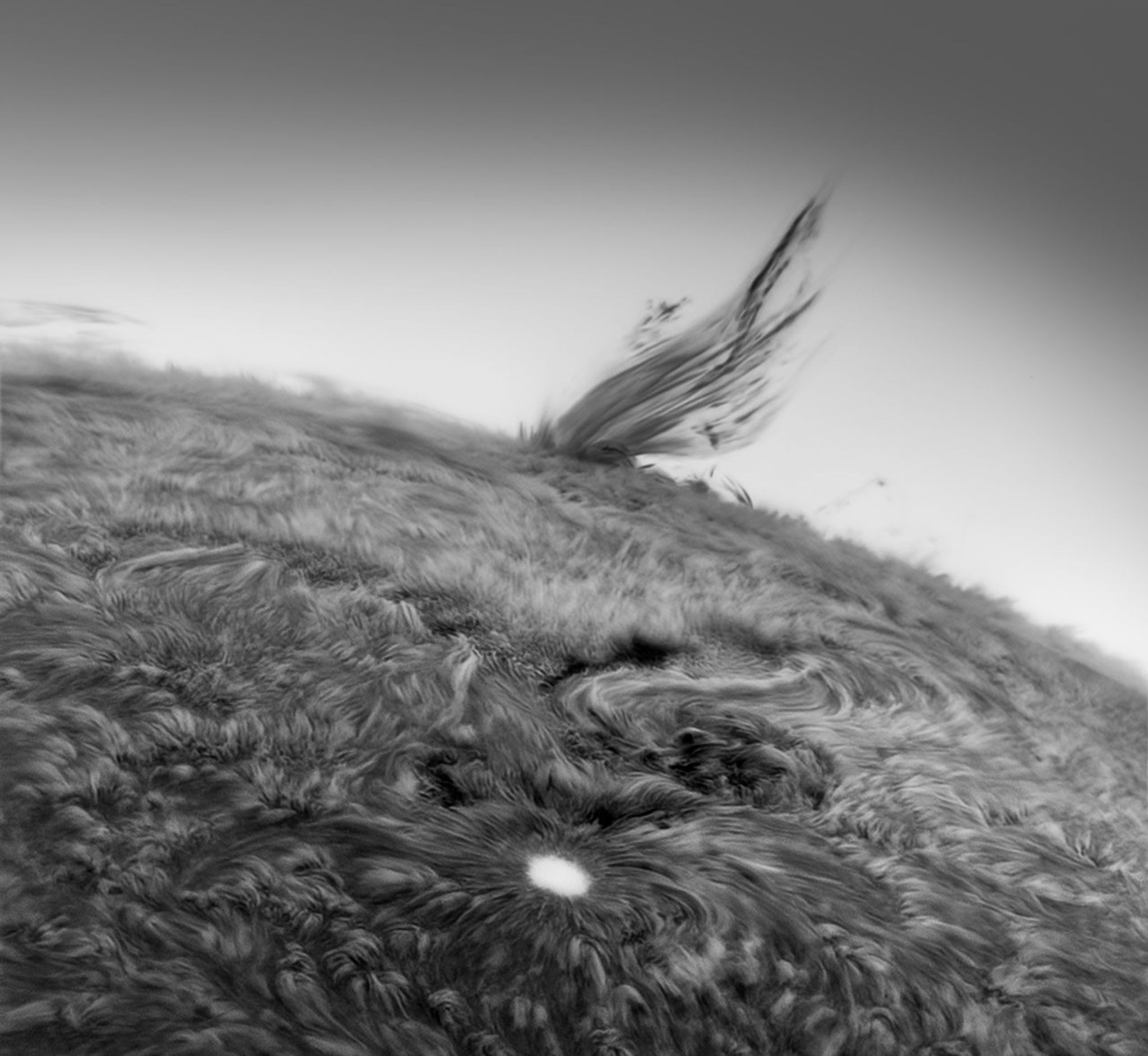
We talk a lot about decentralization as a political or financial ideal, but sometimes nature steps in to remind us that it is actually a physical necessity. This week, NASA’s Astronomy Picture of the Day highlighted an M-class solar flare. To the casual observer, it is a beautiful, looping arc of plasma captured in extreme ultraviolet light. To those of us building the hardware and protocols for the next decade of the internet, it is a reminder that our entire stack sits on a very fragile foundation.
Understanding the Scale of the Event
An M-class flare is essentially a mid-range solar storm. It is not the "X-class" monster that knocks out entire power grids or sends us back to the stone age, but it is powerful enough to cause localized radio blackouts and disrupt satellite operations. The plasma we see in these images is traveling at millions of miles per hour, carrying a magnetic field that can interact violently with our own.
For builders, the physics matters less than the fallout. When these flares hit, they don't just affect NASA. They affect the GPS signals that time-stamp our transactions, the satellites that provide backhaul for remote nodes, and the high-altitude circuitry that keeps our cloud providers running. We are building complex, high-frequency systems on top of a giant ball of fire that occasionally throws a temper tantrum.
The Vulnerability of Centralized Compute
The current AI boom is driven by massive, centralized clusters of H100s. These data centers are efficient, but they are also concentrated points of failure. While modern facilities have shielding, a significant solar event can cause single-event upsets (SEUs)—bit flips in memory or processors—that can corrupt model training or lead to unpredictable AI behavior.
If you are a founder relying entirely on a single region of a single cloud provider, you aren't just at the mercy of their uptime; you are at the mercy of the sun. This is where the intersection of crypto and AI becomes practical rather than theoretical. We need distributed compute not just because it is "censorship-resistant," but because it is resilient. If a flare disrupts a cluster in the Northern Hemisphere, a truly decentralized network should failover to nodes in the South without losing state.
Why Builders Should Care About Space Weather
It sounds like science fiction, but space weather is a legitimate tail risk for any digital asset or autonomous system. Here is how it impacts the builder-first perspective:
- Network Latency: Solar activity can ionize the atmosphere, causing delays in signal propagation. In a world of high-frequency trading and sub-second block times, a few milliseconds of solar interference can lead to massive slippage or missed liquidations.
- Data Integrity: Silent data corruption is the silent killer of databases. While ECC memory catches most bit flips, a heavy solar event increases the probability of errors that bypass standard checks.
- Hardware Lifespan: Constant exposure to increased radiation during solar maximums degrades sensitive electronics over time. For those running their own node infrastructure or mining rigs, this is a long-term depreciation factor.
The Case for Hardened Infrastructure
We spent the last decade building for a world where the internet is always on and the environment is stable. The next decade won't be that way. As we move more of our logic into smart contracts and AI agents, the cost of a system failure moves from "annoying" to "catastrophic."
I am skeptical of most "Space-Tech" crypto projects that promise a satellite in every orbit, but I am very bullish on local-first software and edge computing. If your stack can't run when the backbone is jittery, it isn't robust. We need to be building protocols that assume the connection is intermittent and the hardware is under stress.
The beauty of a solar flare is inversely proportional to the reliability of the grid it hits. We admire the photo, but we should be auditing our failovers.
Building for the Solar Maximum
We are currently approaching the solar maximum, a period of increased activity in the sun's 11-year cycle. This means we are going to see more M-class flares, and likely a few X-class ones, in the coming years. This isn't doom-posting; it's a call for better engineering.
If you are a founder, ask your CTO what happens to your node synchronization if GPS timing signals get noisy. Ask your DevOps team about your multi-region redundancy. If the answer is "we just use AWS East," you have a solar-flare-sized hole in your business plan.
Final Thoughts for the Founder
The NASA image is a reminder that we are small. Our systems, no matter how "distributed" we claim they are, still rely on physical silicon and copper. The builders who win the next decade will be the ones who acknowledge these physical realities rather than ignoring them in favor of clean abstractions.
Don't just build for the sunny days. Build for the days when the sun decides to fight back. High-uptime infrastructure isn't just about code; it's about understanding the environment your code lives in. Treat the sun as a hostile actor in your threat model, and you'll be ahead of 99% of the market.
Read the original at NASA Breaking News →