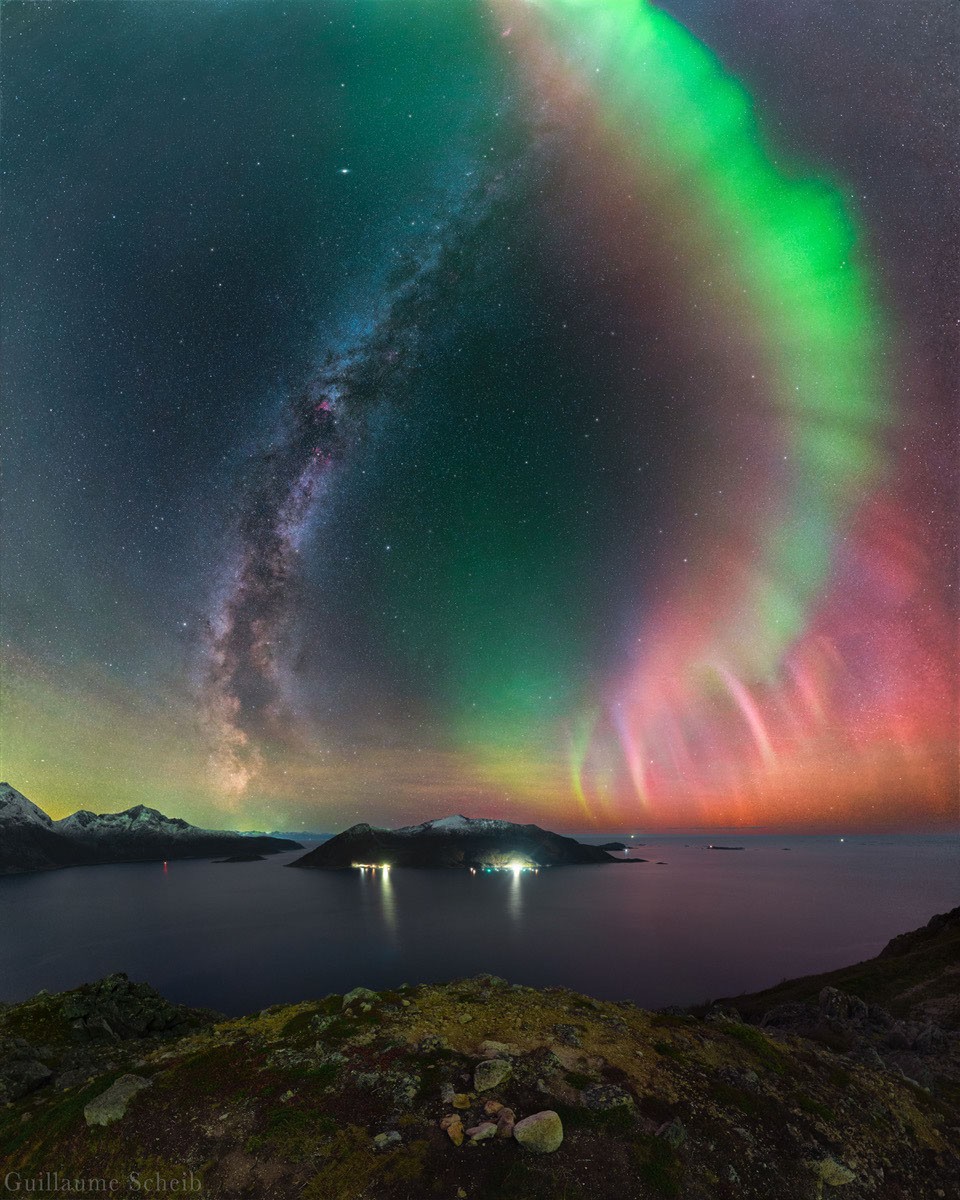
We spend a lot of time looking at screens. Whether you are debugging a smart contract or fine-tuning a neural network, your visual field is usually dominated by artificial light. But NASA just dropped a reminder that the most complex rendering engine in existence doesn't run on a GPU. It runs on physics, solar wind, and the sheer scale of the cosmos.
The Collision of Two Giants
The recent feature from NASA's Astronomy Picture of the Day (APOD) presents a visual standoff: the Milky Way versus an Aurora. To the casual observer, it is just a pretty picture. To those of us building in the tech space, it is a masterclass in layered architecture. You have the Milky Way, a permanent, structural record of where we are in the universe. Then you have the Aurora, a transient, high-energy event caused by solar particles hitting our atmosphere.
It is a rare capture because these two phenomena usually occupy different psychological spaces. The Milky Way is the background noise of the universe—reliable, ancient, and massive. The Aurora is the disruption. It is the sudden spike in traffic, the flash loan that drains a pool, the viral tweet that breaks your server. Seeing them together forces us to reconcile the permanent with the ephemeral.
The Builder's Perspective on Scale
In the crypto world, we talk about "scaling" constantly. We want more transactions per second, more nodes, more reach. But looking at an image like this puts our definition of scale into perspective. The light from those stars in the Milky Way has been traveling for thousands of years to hit that camera sensor. The Aurora, meanwhile, is happening just a few hundred miles up.
As founders, we often mistake the Aurora for the Milky Way. We focus on the flashing lights—the hype cycles, the temporary price pumps, the latest AI wrapper that will be obsolete in six months. We treat these temporary flickers like they are the structural foundation of our industry. But real building is about the stars. It is about the long-term, slow-moving shifts that define an era.
Signal vs. Noise
When you look at the NASA image, the Aurora is brighter. It is more colorful. It demands your attention immediately. In any marketing deck, the Aurora is the hero image. But the Milky Way is the actual signal. It tells you where you are in the galaxy. It is the map.
In your project, the signal is your core utility. It is the problem you actually solve for your users. The noise is the marketing fluff, the speculative frenzy, and the competitive drama. If you build only for the Aurora, you are left in the dark as soon as the solar wind dies down. If you build for the Milky Way, you are building something that lasts long after the flash fades.
Infrastructure and Environment
There is a technical takeaway here regarding environment. The Aurora only happens because Earth has a magnetic field and an atmosphere. It is a byproduct of our planet's specific infrastructure reacting to external stimuli. Without that foundational layer, the solar wind would just be invisible radiation stripping the planet bare.
Think of your protocol or your AI model as the atmosphere. You cannot control the "solar wind" of the market—the macroeconomics, the regulatory shifts, or the sudden breakthroughs from competitors. All you can control is how your infrastructure reacts to those external forces. Does it create something beautiful and functional like an Aurora, or does it just let the radiation through to fry your users?
- Reliability: The Milky Way is the uptime. It is the 99.999% availability that users expect but rarely appreciate until it is gone.
- Interaction: The Aurora is the user experience. It is the visible result of complex backend processes meeting the user's reality.
- Contrast: You need both. A sky with only stars is static; a sky with only Aurora is chaotic. Balance is the key to a sustainable product.
What This Means for the Next Cycle
We are entering a phase where the "pretty lights" of simple AI bots and meme coins are starting to lose their luster. People are looking for the Milky Way again. They want to see the underlying structure. They want to know that if they put their time and capital into a system, it is not going to vanish when the next solar storm passes.
If you are a builder, stop trying to make your project glow brighter than the last one. Instead, make it more permanent. Focus on the data, the security, and the long-term viability of your code. Be the background radiation that stays steady while others flicker out.
The most important things in life and technology are often the ones that have been there the whole time, waiting for the flash to fade so they can be seen again.
The Takeaway
NASA's APOD isn't just a science lesson; it is a reminder of priority. The Aurora is a spectacle, but the Milky Way is the reality. In your work, don't confuse the two. Build for the long haul, appreciate the flashes of brilliance, but never lose sight of the stars that guide the way.
Read the original at NASA Breaking News →