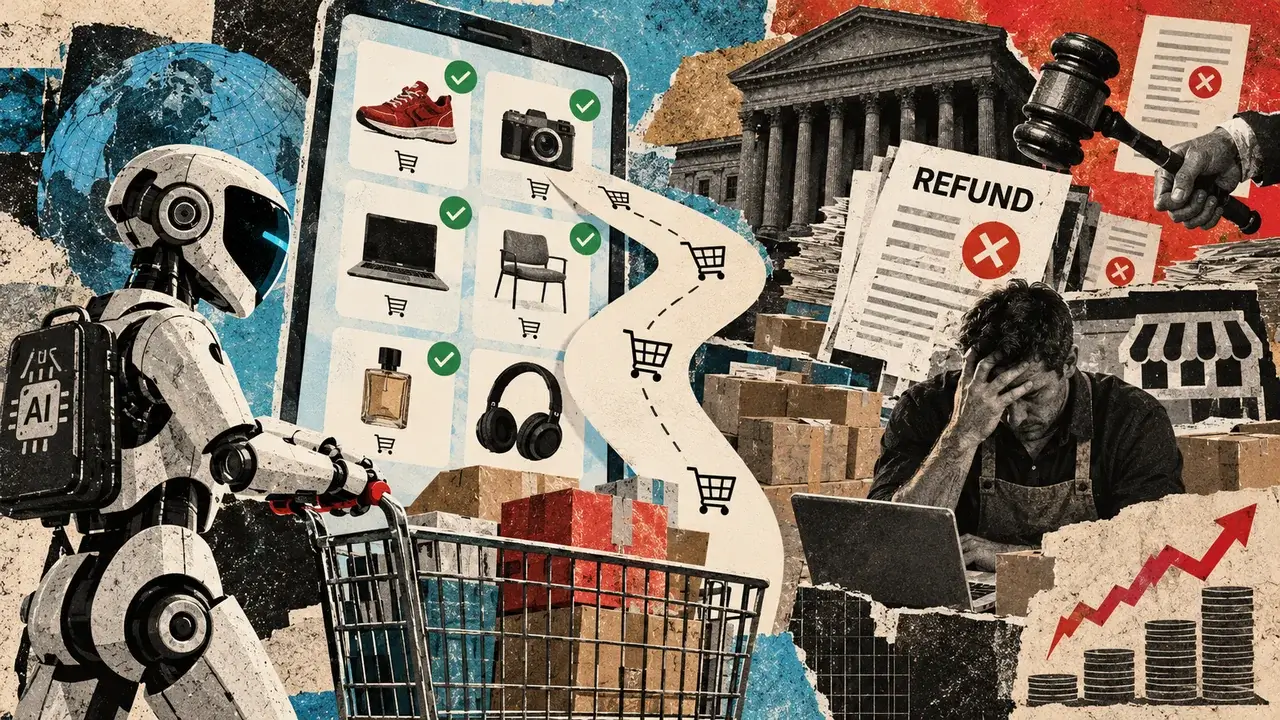
The Era of Autonomous Spending
We have reached the point where software has its own bank account. With the recent integration of Amazon Bedrock’s AgentCore with payment rails from Coinbase and Stripe, AI agents are no longer just chatbots; they are customers. They can identify a service, authenticate their identity, and execute a transaction using stablecoins or the emerging x402 protocol within predefined budget limits.
For years, we talked about the frictionless economy. We wanted to remove the human from the middle of every transaction to speed things up. Well, we got what we asked for. But as a founder who has spent a decade looking at the plumbing of digital commerce, I can tell you that we are about to hit a massive wall. The industry is obsessed with how agents spend money, but nobody is talking about how they get it back.
The Merchant Crisis Nobody Saw Coming
Imagine you run an e-commerce brand doing $50 million a year. Suddenly, 15% of your traffic isn't coming from humans clicking buttons, but from autonomous agents acting on behalf of users. These agents are efficient, they don't get distracted by upsells, and they pay instantly. It sounds like a dream until the first wave of automated disputes hits your dashboard.
The current merchant infrastructure is built on the assumption of human intent. When a human asks for a refund, there is a trail of emotional context or a specific complaint. When an agent decides a service didn't meet its programmed KPIs and initiates a chargeback or a refund request, the merchant is essentially arguing with a wall of code. There is no existing legal or operational framework to handle 'machine-error' disputes at scale.
The Wallet Before the Law
It is a classic crypto and AI move: build the wallet before you build the court. By giving agents the ability to spend via USDC and Stripe, we have front-run the regulatory and consumer protection frameworks that keep the global economy stable. If an agent buys the wrong SKU because of a hallucination, who is liable? The user who gave the prompt? The developer who built the agent? Or the LLM provider that generated the faulty decision?
Currently, the answer is 'nobody knows.' Merchants are facing a potential $6 billion crisis because our fraud detection systems are tuned to catch stolen credit cards, not 'legal' transactions initiated by autonomous bots that may or may not have the right to commit those funds. We are watching a live experiment where the technology has outpaced the basic accounting principles of commerce.
What This Means for Builders
If you are building in the AI space right now, you need to look past the 'wow' factor of an agent buying a pizza. The real opportunity—and the real danger—is in the middle layer of transaction reconciliation. We need 'Agent-to-Merchant' protocols that aren't just about moving money, but about moving metadata. We need a way to prove intent and define the terms of a refund before the transaction even hits the blockchain.
Builders should be focusing on three things right now:
- Verifiable Intent: How do we cryptographically sign the parameters of what an agent is allowed to buy so the merchant can prove they fulfilled the specific request?
- Escrow Logic: Instant settlement is great until the product is defective. We may need to move back toward smart-contract-based escrow for agentic purchases to protect both sides.
- Identity Verification: We need to distinguish between a 'good' agent acting for a verified human and a 'bad' agent script-kiddie-ing its way through checkout pages.
A Founders Reality Check
I am skeptical of the idea that we can just 'fix this later.' The history of the internet is a graveyard of technologies that scaled too fast without a way to handle disputes. Look at the early days of PayPal or the current nightmare of credit card friendly fraud. Now, multiply that by the speed of an AI that can make 1,000 purchases a second.
The industry is building high-speed rails for money, but we haven't built the brakes. When a machine spends money, the concept of 'buyer's remorse' disappears, replaced by 'algorithmic error.' Merchants aren't ready for that distinction.
We are moving into a world where the 'customer' is a line of code. If you are a merchant, you need to start asking your payment processors how they plan to handle agent-based disputes. If you are a developer, stop bragging about how your agent can pay for things and start showing us how it handles a failed delivery or a wrong order. That is where the real value—and the real survival of this ecosystem—lies.
The Hard Truth
The tech is here, and the money is flowing. But until we solve the 'reverse transaction' problem for autonomous entities, we aren't building a new economy; we're just building a more efficient way to create chaos for small and medium businesses. We need to stop treating agents as toys and start treating them as the high-risk financial actors they actually are.
Read the original at CryptoSlate →