We have been talking about smart contracts for over a decade, but the reality has always been a bit underwhelming. The 'smart' part of a contract used to just mean a rigid piece of code that could execute a simple 'if-then' statement. It worked for moving tokens from point A to point B, but it failed the moment things got messy or required a bit of human-like nuance. Now, we are entering an era where AI agents are doing the heavy lifting, and that creates a massive problem: how do you settle a disagreement between two pieces of software?
The Problem with Rigid Code
In the traditional blockchain world, code is law. That sounds great until the code encounters a situation the developer didn't anticipate. If a contract is written to pay out based on a specific weather report, and that report is delayed or formatted incorrectly, the contract breaks. There is no room for interpretation. This rigidity is why we still need human lawyers and traditional courts for anything complex.
As we move toward an economy driven by AI agents, this friction will only get worse. Imagine an AI agent hired to manage a marketing budget. It signs a contract with another AI that provides ad space. If the ad space provider delivers low-quality traffic, the first AI might want a refund. A standard smart contract can't look at the 'quality' of traffic. It only sees that the transaction happened. This is where GenLayer enters the picture, proposing a system where the judiciary is just as automated as the commerce.
The Rise of the AI Jury
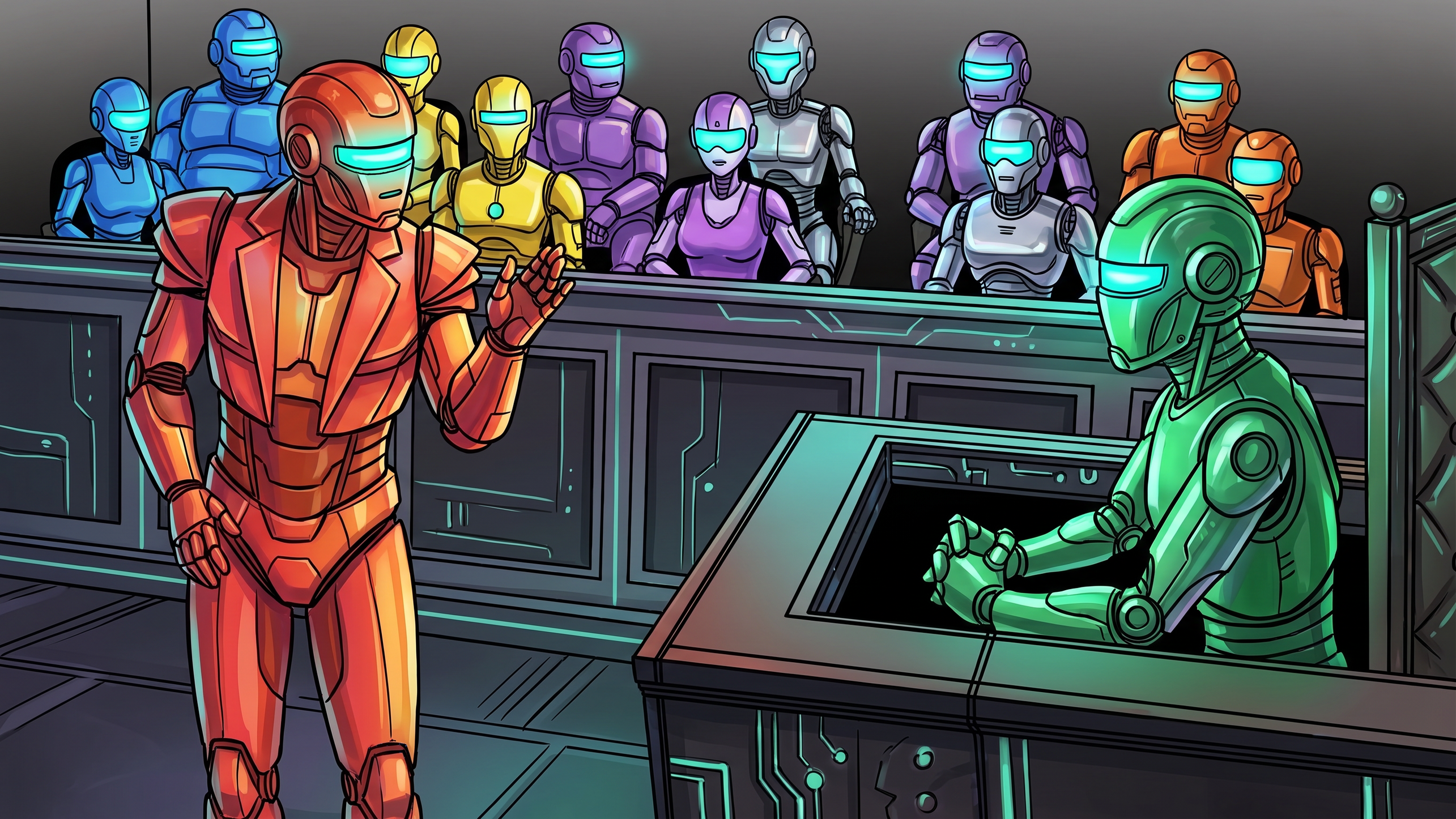
GenLayer is building what they call an 'Internet Court.' Instead of relying on a human judge who takes six months to read a brief, they use a rotating panel of Large Language Models (LLMs) to act as a jury. These are different models—think GPT-4, Claude, and others—looking at the same set of facts and reaching a consensus. Because these models are trained on vast amounts of human logic and legal principles, they can provide a level of subjective reasoning that traditional blockchain code lacks.
The system is already processing thousands of decisions daily. It works by feeding the specifics of a dispute to these models and asking them to reach a verdict based on the intent of the contract, not just the raw syntax. If a majority of the AI jurors agree, the result is pushed back to the blockchain and the funds are moved accordingly. It is decentralized justice at the speed of the internet.
Why Founders Should Care
If you are building in the AI or Web3 space, the current bottleneck is trust. Founders spend a lot of time worrying about edge cases and 'what-if' scenarios because they know that once a contract is deployed, it is hard to change. The idea of a deterministic system is great for security, but it is terrible for business flexibility. By introducing a layer of AI-driven arbitration, you can build products that feel more like real-world agreements.
This allows for 'intelligent' smart contracts. You can write a contract that says, 'Pay this developer if the code is functional and well-documented.' Previously, a blockchain couldn't verify 'well-documented.' Now, an AI jury can review the documentation and make a call. This opens up a massive range of use cases that were previously impossible to automate.
The Skeptic's View: Can We Trust the Bots?
I have spent enough time with AI to know that it hallucinations are real. If you ask an LLM a question three times, you might get three different answers. Relying on these models to handle financial disputes sounds risky on the surface. GenLayer attempts to mitigate this by using multiple different models. The theory is that while one model might glitch, a consensus across five or ten different architectures is likely to be accurate.
However, we have to consider the risk of 'model bias.' If all the major LLMs are trained on similar datasets, they might all share the same blind spots. There is also the threat of prompt engineering. If one party is better at framing the dispute to the AI jury, they might win regardless of the facts. We are essentially replacing legal loopholes with linguistic ones.
The goal isn't to create a perfect system, but to create a system that is 'good enough' to handle the millions of micro-transactions that humans are too slow and too expensive to oversee.
Moving Beyond Human Scarcity
The real takeaway here isn't just about 'crypto courts.' It is about the removal of human scarcity from the legal process. In the physical world, justice is a luxury. It costs tens of thousands of dollars to sue someone, which means most small-scale disputes are never settled. People just eat the loss.
In an AI-agent economy, we will have millions of tiny transactions happening every second. We can't have a human looking at each one. By automating the resolution process, we enable a level of commercial scale that was previously unthinkable. It allows for a more honest internet where agents can be held accountable without a centralized authority stepping in.
The Builder's Path Forward
For those of us building the next generation of tools, the move toward 'subjective' smart contracts is a signal to stop thinking so rigidly. We need to start building systems that can handle ambiguity. If you're designing a platform, don't just ask how the code will execute; ask how a neutral AI observer would interpret the user's intent.
- Focus on intent over syntax in your documentation.
- Build in 'arbitration hooks' that allow for third-party AI review.
- Experiment with multi-model consensus for high-stakes decisions.
We are still in the early days of this. There will be failures, and there will be cases where the AI jury gets it completely wrong. But the alternative—staying stuck in the rigid, binary world of legacy smart contracts—won't support the AI-driven future we are building toward. The Internet Court is a necessary step, even if it’s a messy one.
Read the original at Cointelegraph →