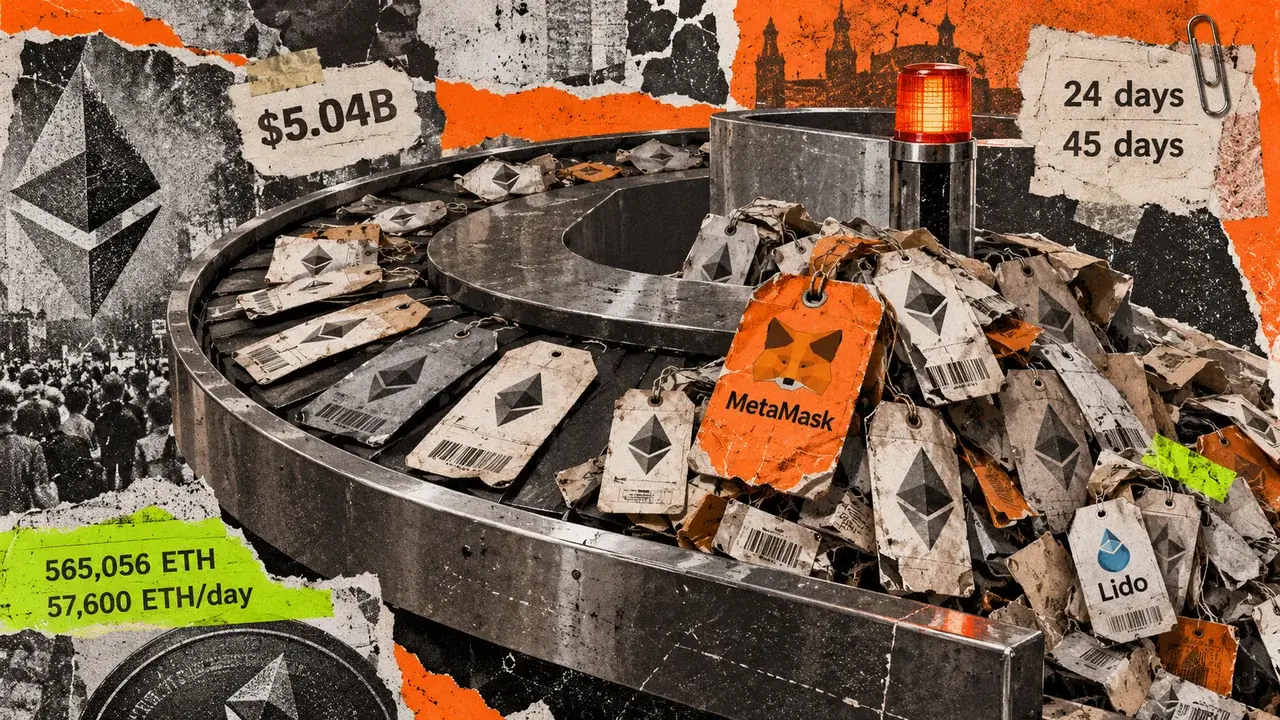
We talk a lot about the decentralization of Ethereum, but we rarely talk about the plumbing that actually makes it work. A recent incident involving MetaMask and Lido shows just how narrow the pipes really are. It started with a minor $1,000 transaction error, but the math behind the fix suggests we could be looking at a $5 billion traffic jam in the staking queue.
The Fragility of the Middleware
Here is the situation. A small technical hiccup in the way MetaMask communicates with Lido led to a series of forced exits. For the uninitiated, exiting a stake on Ethereum isn't like hitting "undo" on a website. It is a protocol-level event that triggers a sequence of wait times and validator cycles. When a user or a service provider triggers an exit by mistake, they cannot just hop back in.
The scale of this specific incident is what should worry founders. Data from Bitquery suggests that if this cohort of exited validators tries to re-enter the network all at once, the sheer volume of capital could exceed $5 billion. In a system designed for stability, sudden surges like this turn the entrance and exit queues into a massive bottleneck.
Why the Staking Queue Matters
Ethereum uses a queue system to protect the network from rapid shifts in security. You cannot just spin up a million nodes in a second, and you cannot shut them all down at once. This prevents a malicious actor from quickly taking over or abandoning the chain. However, this safety mechanism becomes a liability when automated systems or user interface errors trigger mass exits.
When the queue fills up, it creates a delay for everyone. If you are a builder launching a dApp that relies on liquid staking yields, a clogged queue means your users are stuck in limbo. Their capital is not earning, but it is not liquid either. It is the crypto equivalent of being stuck on the tarmac because of a paperwork error at the gate.
The Lido Factor
Lido remains the giant in the room. They have expressed that they expect a gradual re-entry of these funds, rather than a catastrophic spike. That is a comforting thought, but as founders, we should not rely on the optimism of a single large entity. The fact that a $1,000 incident can even theoretically trigger a multi-billion dollar congestion event highlights a single point of failure in the user experience.
The problem is not the Ethereum protocol itself; the protocol is doing exactly what it was coded to do. The problem is the layer of software between the user and the protocol. We are building massive financial structures on top of interfaces that can still be tripped up by basic communication errors.
The Founder's Perspective
If you are building in the DeFi or infrastructure space, there are three things you need to take away from this. First, your UI is a security feature. If a button can trigger a non-reversible protocol action, the friction needs to be intentional. We have spent years trying to make crypto "seamless," but sometimes seams are there for a reason.
Second, we need better visibility into queue health. Most users have no idea what the entry or exit churn limit is on Ethereum. They just see that their money is "pending." When transparency is missing, trust evaporates. We need dashboards and analytics that are baked into the wallet level, not just tucked away on specialized data sites.
Third, we need to stop pretending that liquid staking is a risk-free abstraction. It is a complex financial product built on top of a rigid protocol. When the underlying protocol has a waiting list, the abstraction starts to break down. If $5 billion tries to move through a door built for $100 million, someone is going to get squashed.
The Long Wait Ahead
The math is simple and sobering. Ethereum can only process a certain amount of staked ETH per epoch. If this $5 billion wave hits the entrance queue, we are looking at weeks, if not months, of congestion. This is not just a problem for the people who exited; it is a problem for every new validator trying to join the network.
This creates a secondary market for "fast-track" solutions, which usually means more centralization. When the public highway is blocked, people pay for private roads. We should be working to make the public highway more resilient, rather than just hoping no one trips over the guardrail again.
The intersection of AI and blockchain will only make this worse. As we hand over transaction management to autonomous agents, the speed at which these "errors" can scale increases exponentially. An AI doesn't just make a $1,000 mistake; it makes that mistake ten thousand times in a millisecond.
What Happens Next?
We are going to see how well the Ethereum queue handles the stress test. If Lido is right and the re-entry is gradual, we might dodge a bullet. But the fact that we are even talking about a $5 billion bottleneck because of a minor MetaMask issue should be a wake-up call. We are building a global financial system on top of tools that are still in their experimental phase.
For those of us building the next generation of these tools, the mission is clear: we need to build systems that fail gracefully. A user error should never lead to a protocol-level traffic jam. Until we solve the middleware problem, we are all just one bad click away from a billion-dollar headache.
Read the original at CryptoSlate →